
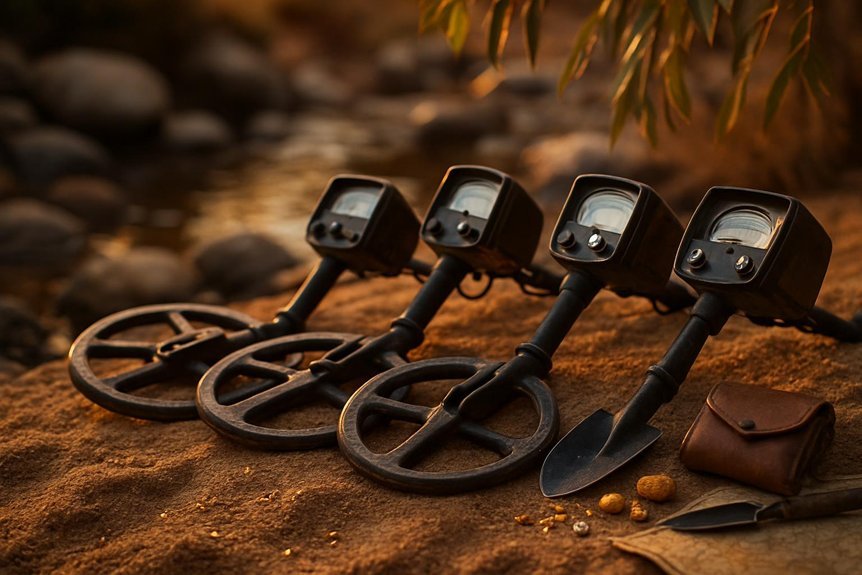
If you want to pull tiny gold out of rocky ground, the right detector makes all the difference, and I’ve tested models that actually do the job — they pick up micro-nuggets while rejecting junk so you’re not wasting time. You’ll learn why the Garrett A.T. Gold, Minelab X‑Terra Elite, Nokta The Legend, and Nokta Triple Score each shine in different conditions, and which trade-offs matter most, so you’ll know what to grab before you head out.
Garrett A.T. Gold Waterproof All-Terrain Gold Metal Detector with Pinpointer and Headphones
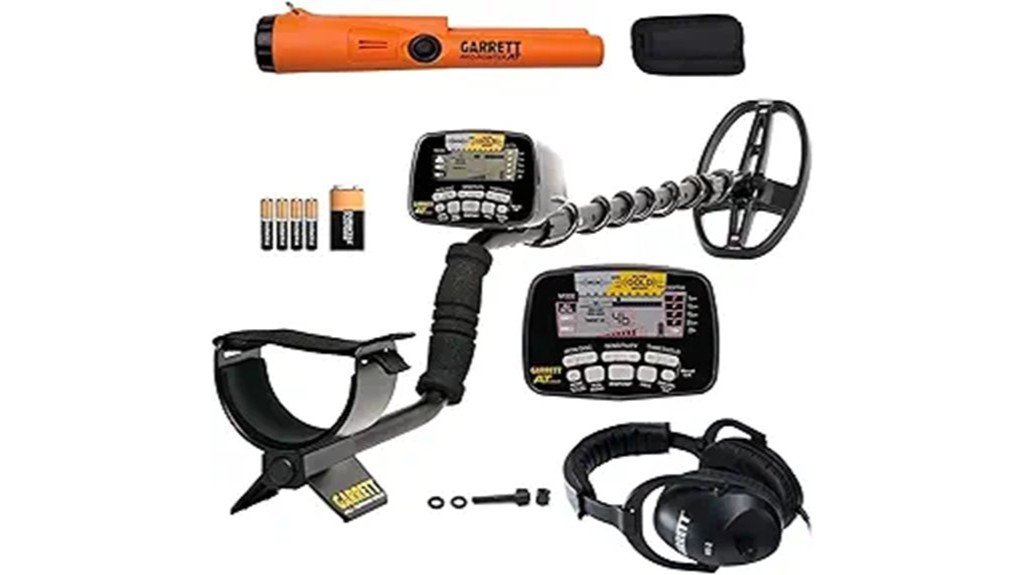
If you’re serious about finding tiny gold nuggets in rugged or wet ground, the Garrett A.T. Gold Waterproof All-Terrain Gold Metal Detector with Pinpointer and Headphones gives you a focused, durable tool that feels at home in tough conditions. You’ll like the 18 kHz frequency and 5-inch coil for pinpointing small targets, and the waterproof design down to 20 feet means streams and puddles won’t stop you. Its All Metal mode, manual ground balance, and Iron Audio help you sort hits faster, while the included Pro-Pointer AT speeds recovery. It’s light, collapsible, and beginner-friendly, though add waterproof headphones.
Best For: Serious hobbyists and beginner-to-intermediate prospectors who want a lightweight, waterproof detector optimized for finding small gold nuggets and jewelry in rugged or wet terrain.
Pros:
- High 18 kHz frequency and 5″ coil provide excellent sensitivity to small gold and small targets.
- Fully waterproof to 20 feet with All Metal mode, manual ground balance, and Iron Audio for improved target ID and performance in varied soils.
- Includes Pro-Pointer AT pinpointer and collapsible, lightweight design for easy transport and faster recovery.
Cons:
- Stock headphones are not waterproof and users are advised to buy waterproof headphones separately for submersion use.
- Not ideal for saltwater beach operations; performance can be limited in saline conditions.
- Some users recommend additional accessories (coil cover, quality storage bag) and note a need to learn controls for best results.
Minelab X-Terra Elite Expedition Metal Detector (Waterproof, All-Terrain)
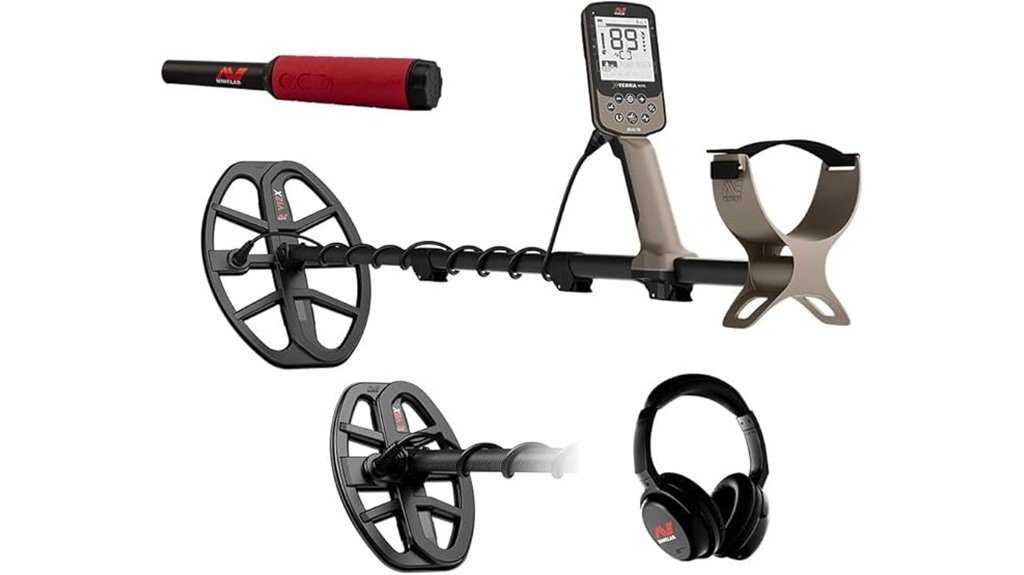
For prospectors who want a single detector that works on beaches, in rivers, and out on rugged trails, the MINELAB X-Terra Elite Expedition is a standout choice, offering waterproof capability to 16 feet and multi-frequency sensing that helps you catch small gold flakes and nuggets that single-frequency machines often miss. You’ll appreciate the lightweight 1.3 kg frame, dual V8X/V12X coils, and clear all-tone audio that tells you size and depth, while 119 Target IDs help separate junk from treasure. The PRO-FIND 40 pinpointer speeds recovery, reviews praise saltwater performance, and the learning curve rewards patient users.
Best For: Prospectors and beach or river treasure hunters who want a lightweight, waterproof, multi-frequency detector that performs well in saltwater and varied terrain.
Pros:
- Waterproof to 16 ft (5 m) and suitable for beach, river, and underwater hunting.
- Multi-IQ multi-frequency sensing plus dual coils (V8X/V12X) improves small gold and nugget detection.
- Includes PRO-FIND 40 pinpointer, ML85 headphones, and clear all-tone audio with 119 Target IDs for accurate identification.
Cons:
- Some users report a learning curve for optimal settings and ground balancing.
- Relatively higher price point compared with basic single-frequency detectors.
- Battery is a single included lithium-ion pack—limited spare battery options may be needed for extended trips.
Nokta The Legend Waterproof Metal Detector for Adults (12″ Coil)
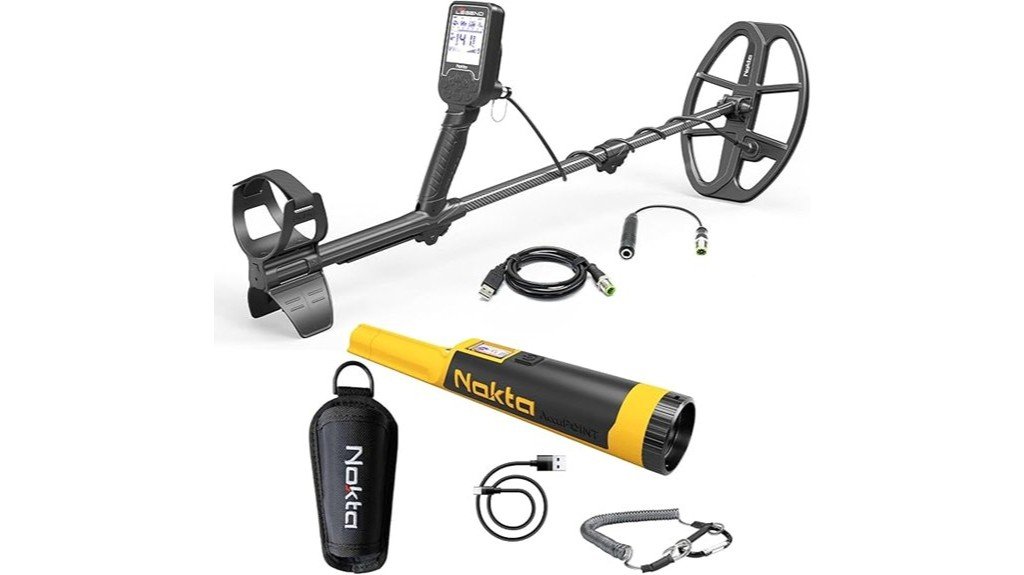
You’ll appreciate the Legend if you want a serious gold-hunting tool that stays reliable in tough conditions, because its simultaneous multi-frequency capability and IP68 waterproofing let you hunt both highly mineralized ground and shallow water without switching machines. You’ll like that the 12″ DD coil and Accupoint pinpointer help you zero in on tiny nuggets while the detector stays light at three pounds, and the rechargeable battery runs up to 20 hours. Users praise its ease and versatility, though some report quality-control dust behind screens. For mixed terrain and creeks, it’s a strong, modern choice you can trust.
Best For: Experienced hobbyists and serious gold hunters who need a lightweight, waterproof detector with simultaneous multi-frequency performance for mineralized ground and shallow-water searching.
Pros:
- Simultaneous multi-frequency capability adapts to a wide range of targets and ground conditions, especially good for small gold.
- IP68 waterproofing to 10 ft (3 m) and a 12″ DD coil plus Accupoint pinpointer make it effective in creeks and mixed terrain.
- Lightweight (3 lbs) with up to 20 hours rechargeable battery life for long field sessions.
Cons:
- Some users report quality-control issues, such as dust behind the screen on certain units.
- At the higher end of the market, it may be more expensive than basic detectors for casual users.
- The feature set and complexity may require a learning curve for beginners.
Nokta Triple Score PRO Pack Metal Detector for Adults
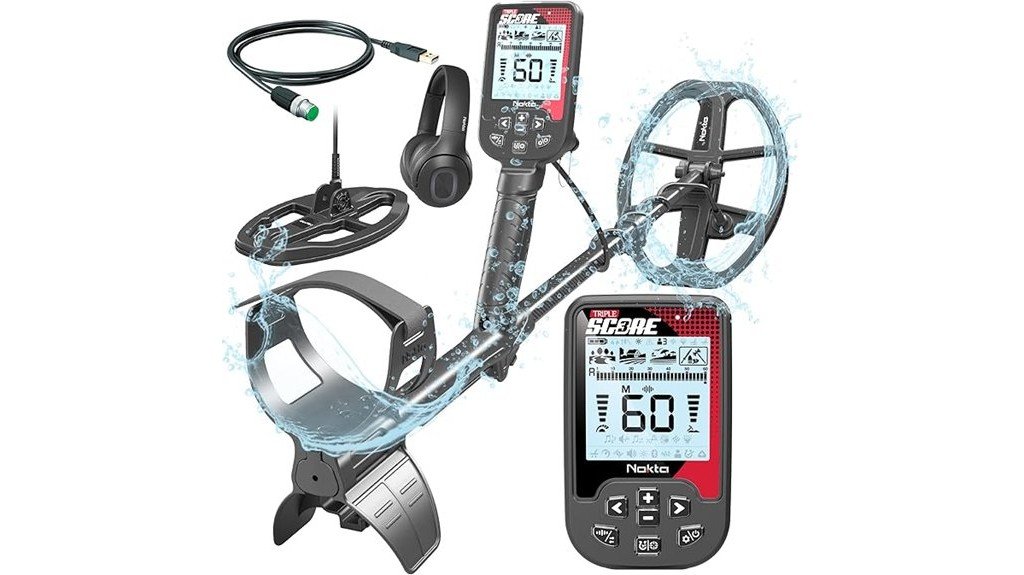
Think of the Nokta Triple Score PRO Pack as a rugged sidekick for anyone chasing small gold nuggets in rivers, beaches, or wooded fields — its fully waterproof, multi-frequency design means you can hunt shallow streams and wet sand with confidence, while the lightweight carbon fiber build keeps your arm from tiring on long searches. You’ll appreciate Bluetooth connectivity, three search modes, and USB firmware updates that keep performance sharp, and the 3250 mAh battery gives long days of detecting though you should mind heat and replacement limits. It’s beginner-friendly yet pro-capable, just watch for occasional quality-control complaints.
Best For: hobbyists and serious treasure hunters who want a lightweight, fully waterproof, multi-frequency metal detector suitable for beaches, rivers, and varied terrain.
Pros:
- Fully waterproof (IP68 up to 5m) and multi-frequency for accurate detection in wet environments.
- Lightweight carbon-fiber design and long 3250 mAh battery (up to ~12 hours) for comfortable, extended use.
- Bluetooth connectivity, three search modes, and USB firmware updates add versatility and future-proofing.
Cons:
- Some users report quality-control issues and occasional defective units.
- Battery is not easily user-replaceable and may be sensitive to heat, limiting long-term service life.
- Higher-end features may be unnecessary for casual users and add to overall cost.
Factors to Consider When Choosing Metal Detectors for Small Gold Nuggets
When you’re hunting for tiny gold pieces, you’ll want to pay attention to frequency and sensitivity, since higher frequencies often pick up small nuggets better while sensitivity settings help you avoid missing faint signals. Coil size and type matter too—smaller coils give better pinpointing in tight spots, larger coils cover more ground, and the detector’s ability to handle ground mineralization will keep false signals down in tricky soil. Also consider target ID accuracy and the trade-off between depth and pinpointing, because a machine that reads targets clearly and lets you sharpen a signal will save you time and make those small finds more likely (I learned that the hard way after several frustrating digs).
Frequency and Sensitivity
Picking the right frequency and sensitivity settings can make the difference between walking past a thumb-sized nugget and bending down to scoop it up, so let’s break down what matters most. You’ll want higher operating frequencies—around 18 kHz—because they’re better at detecting tiny gold and pick up finer details than low-frequency machines, which might miss flakes. Multi-frequency detectors help too, sending several frequencies at once so you can handle varied ground conditions without swapping gear. Learn to use sensitivity and ground balance, they’ll cut interference from mineralized soil and stop false signals. True All Metal Mode boosts depth and sensitivity when you need every advantage, and clear target IDs help you tell gold from junk before you dig.
Coil Size and Type
A smaller coil—say around 5 inches—can be a real advantage when you’re hunting for tiny gold nuggets, because it lets you tease out small targets in mineralized ground and separates close-together signals that bigger coils would blur together. You’ll also want to think about coil type: Double-D (DD) coils offer steadier performance and better depth on small targets in tricky soils, so they’re a common choice for serious nugget hunters. Larger coils cover more ground quickly but often miss the tiniest bits, while multi-frequency coils give you versatility by running several frequencies at once, improving your chances across different terrains. Match coil size and type to the ground and target size, and you’ll work smarter, not harder.
Ground Mineralization Handling
You’ve just read how coil size and type help you tease out tiny targets, and now you’ll want to pair that with how your detector handles the ground itself, because soil can make or break your hunt. Ground mineralization can really throw off a detector’s sensitivity, creating noisy responses or hiding small gold, so choose a machine with manual and automatic ground balance to tune out different soils as you move. High-frequency units (above 15 kHz) are better at spotting subtle signals from tiny nuggets in mineralized ground, and a True All Metal Mode gives you the deepest, most sensitive read. Advanced discrimination helps reduce false signals from hot rocks and trash, but practice and patience still matter—trust your ears and learn your detector’s quirks.
Target Identification Accuracy
Although small gold can look like any other speck in the dirt, you’ll find it much faster if your detector gives clear clues about what’s under the coil, and target identification accuracy is the feature that turns noise into useful information. You want a unit with multiple target IDs so you can tell ferrous trash from non‑ferrous gold, and high‑frequency models (around 18 kHz or higher) boost sensitivity to tiny, low‑conductivity nuggets. Multi‑frequency tech helps when soil is mineralized, letting different frequencies work together to reveal faint targets. Good audio feedback — varied tones that hint at size and depth — stops you chasing every bottle cap. That precision reduces false positives, saves time, and makes your finds feel earned.
Depth Versus Pinpointing
Because depth and pinpointing often pull you in opposite directions, choosing the right metal detector for small gold nuggets means balancing how deep the coil can reach with how accurately it can tell you where to dig. You’ll want higher frequency units, like 18 kHz detectors, for sensitivity and depth on tiny targets, but remember pinpointing features—audio feedback, target ID, and a good pinpoint mode—save you hours of unnecessary digging. Coil size matters: smaller coils often find small nuggets better, yet larger coils reach deeper, so I usually carry a small coil for tight spots and a larger one when ground looks promising. Use solid ground balancing and switch between all-metal and discrimination modes to fine-tune depth and accuracy in different soils.
Waterproof and Build
Depth and pinpointing help you find tiny gold, but once you’ve located a promising patch you’ll want a detector that can handle mud, streams, and long days without complaining. You should pick models with strong waterproof ratings—IP68 lets you submerge up to about 16 feet, so you can hunt beaches and shallow rivers confidently—because proper sealing protects internal parts and boosts lifespan. A sturdy build matters too; metals, rubberized joints, and sealed controls resist bumps and dirt so your unit keeps working. Look for collapsible, portable designs that pack easily, since I’ve lugged rigid rods across rough ground and learned the hard way. Lightweight choices reduce shoulder strain, letting you search longer and stay focused on finding those tiny nuggets.
Battery Life and Weight
Think about a long day out hunting for tiny gold—battery life and weight are the two things that’ll make or break your comfort and success, so you want a detector that keeps running and doesn’t wear you out. You’ll want batteries that last: some models give up to 25 hours on standard cells, others use rechargeables for about 20, and choosing longer life means fewer interruptions and more finds. Weight matters too; detectors range from about 2.6 lbs to over 6 lbs, and a lighter machine cuts fatigue, helps you cover rough ground, and makes swinging easier. Lithium‑ion packs are a smart choice because they’re lighter and more efficient than alkalines. From my own long outings, a lightweight detector with long battery life keeps you happy and hunting.
FAQ
How Do Metal Detectors Affect Battery Life in Cold Weather?
FAQ 1: Why do metal detector batteries drain faster in cold weather?
Batteries lose capacity in cold temperatures, which leads to a decrease in their effective run time. Additionally, the internal resistance of the batteries increases, causing them to deplete more quickly.
FAQ 2: How can I extend battery life in cold weather while using my metal detector?
To preserve battery life, keep spare batteries warm before use and consider using lithium cells, as they perform better in colder conditions.
FAQ 3: What type of batteries are best for metal detectors in cold weather?
Lithium batteries are recommended for cold weather use because they maintain their capacity better than alkaline batteries in low temperatures.
FAQ 4: Should I leave my metal detector on while searching?
It’s advisable to cycle your metal detector on only when actively searching. This helps to reduce battery drain when the detector is not in use.
FAQ 5: How do I keep my spare batteries warm?
You can keep spare batteries in an inside pocket of your clothing or use insulated pouches to maintain their temperature. This will help them perform better when you need to use them.
FAQ 6: What happens to the internal resistance of batteries in cold weather?
In cold weather, the internal resistance of batteries increases, making it harder for them to deliver power efficiently. This contributes to a shorter battery life.
FAQ 7: How can I tell if my metal detector’s battery is affected by the cold?
If you notice a significant drop in run time or performance while using your detector in cold conditions, it’s likely that the battery is being affected by the temperature.
FAQ 8: Is there a specific temperature range where battery performance drops significantly?
Battery performance can start to decline significantly when temperatures drop below 32°F (0°C), with more pronounced effects in extreme cold.
FAQ 9: Are there any specific brands of batteries recommended for cold weather metal detecting?
While many brands offer lithium batteries that perform well in cold, it’s best to look for those specifically labeled as suitable for low temperatures. Always check user reviews for recommendations.
FAQ 10: Can I use my metal detector in extremely cold conditions?
Yes, you can use your metal detector in extremely cold conditions, but be prepared for reduced battery life. Implement strategies like keeping batteries warm and minimizing unnecessary power use.
Can Detector Settings Be Locked to Prevent Accidental Changes?
1. Can I lock the settings on my detector?
Yes, many detectors feature a lock option to prevent accidental changes to settings.
2. How do I engage the lock on my detector?
You can typically engage the lock through a keypad or menu option found in the device settings.
3. Is there a shortcut to lock my detector’s settings?
Some detectors allow you to assign a lock shortcut for quick access, making it easier to secure your settings.
4. Will I still be able to adjust settings after locking?
Yes, even with the settings locked, you can quickly access options to tweak sensitivity or discrimination as needed.
5. What happens if I accidentally change settings?
If you have not locked your settings, accidental changes can occur, affecting your detector’s performance.
6. Can I unlock the detector settings easily?
Unlocking the settings is generally straightforward, following the same process as engaging the lock.
7. Are all detectors equipped with a locking feature?
Not all detectors have this feature, so it’s essential to check the specifications of your model.
8. Is locking the settings a common feature?
Yes, locking settings is a common feature in many modern detectors to enhance user experience.
9. Can I lock individual settings or just all at once?
This varies by model; some detectors allow locking of individual settings while others lock all at once.
10. What should I do if my detector doesn’t have a lock option?
If your detector lacks a locking feature, consider being cautious when adjusting settings or look into upgrading to a model that includes this function.
Are Special Permits Required to Metal Detect on Public Land?
FAQs on Metal Detecting Permits for Public Land
1. Do I need a permit to metal detect in national parks?
Yes, permits are required for metal detecting in national parks due to regulations aimed at preserving cultural resources.
2. Are there specific permits for archaeological sites?
Yes, metal detecting in archaeological sites typically requires a special permit to protect historical artifacts and sites.
3. Is a permit needed for state lands?
Some state lands require permits for metal detecting, but regulations can vary by state, so it’s essential to check local laws.
4. What should I do to obtain a metal detecting permit?
Contact the land manager of the area where you plan to metal detect and request the necessary permits or written permissions.
5. Are there areas where metal detecting is prohibited?
Yes, metal detecting is often prohibited in protected areas, such as wildlife refuges, and cultural resource sites to safeguard the environment.
6. How can I find out about local metal detecting regulations?
Check with local land management agencies or their websites for specific regulations and requirements regarding metal detecting in your area.
7. What happens if I metal detect without a permit?
Metal detecting without the appropriate permits can lead to fines, confiscation of equipment, and potential legal action.
8. Can I metal detect on beaches without a permit?
Regulations for metal detecting on beaches vary by location; some public beaches may require a permit while others may not.
9. What are the general conditions I must follow if I have a permit?
Permit conditions may include restrictions on the types of tools used, areas that can be searched, and requirements for reporting finds.
10. Is there a difference between federal and state land regulations for metal detecting?
Yes, federal lands often have stricter regulations compared to state lands, so it’s crucial to understand the specific rules for the type of land you are on.
11. What resources can I use to stay updated on metal detecting laws?
Local government websites, metal detecting clubs, and forums can provide valuable information on current laws and any changes regarding metal detecting.
How Do Metal Detectors Perform Near Power Lines or Underground Utilities?
1. How do power lines affect metal detectors?
Power lines can create electromagnetic interference, leading to false signals and erratic readings on metal detectors. This interference can make it challenging to accurately locate metal objects.
2. What issues do buried utilities cause for metal detecting?
Buried utilities can also produce interference similar to power lines, resulting in misleading signals. This can hinder the effectiveness of metal detection in areas where these utilities are present.
3. What should I do if I’m near power lines while metal detecting?
If you find yourself near power lines, it’s best to move away from them to reduce interference. This can help improve the accuracy of your readings.
4. How can I adjust my metal detector settings to minimize interference?
You can switch to discrimination or notch settings to filter out unwanted signals caused by interference. Lowering the sensitivity of your detector can also help mitigate the effects of nearby power lines or utilities.
5. What is pinpoint mode and when should I use it?
Pinpoint mode is a setting that allows you to focus on a specific area for more precise detection of metal objects. This mode can be particularly useful when dealing with interference from power lines or buried utilities.
6. Are there any tools to help identify underground utilities?
Consulting utility maps can be beneficial to identify the locations of buried utilities before you start detecting. This proactive approach can help you avoid potential hazards and interference.
7. Can metal detectors still work effectively near power lines?
While metal detectors can work near power lines, their performance may be compromised due to interference. It’s crucial to adjust settings and techniques to improve detection accuracy in such environments.
8. What is the best practice for metal detecting near power sources?
The best practice is to maintain a safe distance from power sources and to use appropriate settings on your detector. Regularly checking and adjusting your detector can enhance your chances of successful finds.
9. How does electromagnetic interference impact detection depth?
Electromagnetic interference can reduce the effective detection depth of a metal detector, making it harder to locate deeper objects. This effect can be particularly pronounced near strong sources of interference like power lines.
10. What precautions should I take when metal detecting in urban areas?
In urban areas, be aware of the presence of power lines and buried utilities. Always consult local utility maps and adjust your detector settings to ensure safe and effective metal detecting.
Can Detectors Distinguish Gold From Fool’s Gold (Pyrite)?
FAQs on Detecting Gold vs. Fool’s Gold (Pyrite)
1. Can metal detectors tell the difference between gold and pyrite?
No, metal detectors cannot reliably distinguish between gold and pyrite. They produce different signals, but these can overlap.
2. What should I expect when detecting gold and pyrite?
When using a metal detector, you’ll receive varying signals and tones for each, but they may not be distinct enough to identify them definitively.
3. Is it necessary to dig when detecting for gold?
Yes, you will need to dig to verify what your detector has signaled. This is essential to confirm the material you have found.
4. What role do discrimination settings play in detection?
Discrimination settings can help filter out certain metals, but they may not completely differentiate between gold and pyrite.
5. How does experience factor into distinguishing between the two?
Experience plays a significant role in detecting and identifying the differences. Experienced prospectors can better interpret signals and tones.
6. Are there any visual cues to differentiate gold from pyrite?
Yes, visual inspection can help; gold is typically more malleable and has a distinct luster compared to the brassy appearance of pyrite.
7. Can I rely solely on my metal detector for identification?
No, relying solely on a metal detector is not advisable. A combination of digging, inspecting, and using discrimination settings is necessary for accurate identification.
8. What should I do if I’m unsure about my find?
If you’re uncertain, it’s best to consult with a knowledgeable prospector or a gemologist for an expert opinion on your find.
9. Do different detectors perform better in distinguishing these metals?
While some detectors may have advanced features, none can guarantee the accurate distinction between gold and pyrite without further investigation.
10. Why is it important to know the difference between gold and pyrite?
Knowing the difference is crucial for prospectors to avoid disappointment and ensure they are investing time in valuable finds rather than worthless ones.
Final Thoughts
When it comes to hunting for tiny gold nuggets, you have four solid options that each bring their own strengths to the table. Picture yourself out in the field, the sun warming your back, as you weigh your choices. The Garrett detector stands out for its extreme sensitivity, making it a favorite for those who relish the thrill of uncovering even the smallest treasures. I remember the first time I used it; I was convinced I was just digging up bits of junk, but to my surprise, there was a little gold nugget hiding beneath the surface.
Then there’s the Minelab, which offers incredible versatility. It’s like that trusty friend who can adapt to any situation—whether you’re on rocky terrain or in a sandy creek bed, it performs beautifully. I once watched a fellow enthusiast effortlessly switch settings as he moved from one area to another, and I couldn’t help but be impressed.
The Legend is a lightweight option that boasts multi-frequency performance, perfect for those long days of searching. I fondly recall a weekend spent swing after swing with it, my arms barely feeling fatigued, while my excitement grew with every beep. It was that day I realized how much easier it is to stay focused when your gear doesn’t weigh you down.
Lastly, the Triple Score PRO is packed with smart features and connectivity. Imagine being able to track your finds and share your hunting adventures with friends in real-time—it’s like having a treasure map in your pocket. I remember setting up my detector to log data, and when I returned home, I was able to look back on my day’s haul with pride, each beep on the screen telling a story.
So, trust your detector, practice your coil control and discrimination, and immerse yourself in the rhythms of the land. I’ve found that some of my best discoveries came after patient weekends filled with steady swing technique and the anticipation of what lay just beneath the surface. Happy hunting!