
You want a detector that lets you tune recovery speed so you don’t miss coins tucked beside iron trash, and these four models deliver that control with real precision. I’ve tested similar gear in parks and riverbanks, and adjustable recovery makes tight targets actually separable — saving you time and frustration. Below are the Nokta Triple Score PRO, Minelab Manticore, and two Legend options, each with strengths that might change how you hunt, so keep going.
Nokta Triple Score PRO Pack Metal Detector for Adults
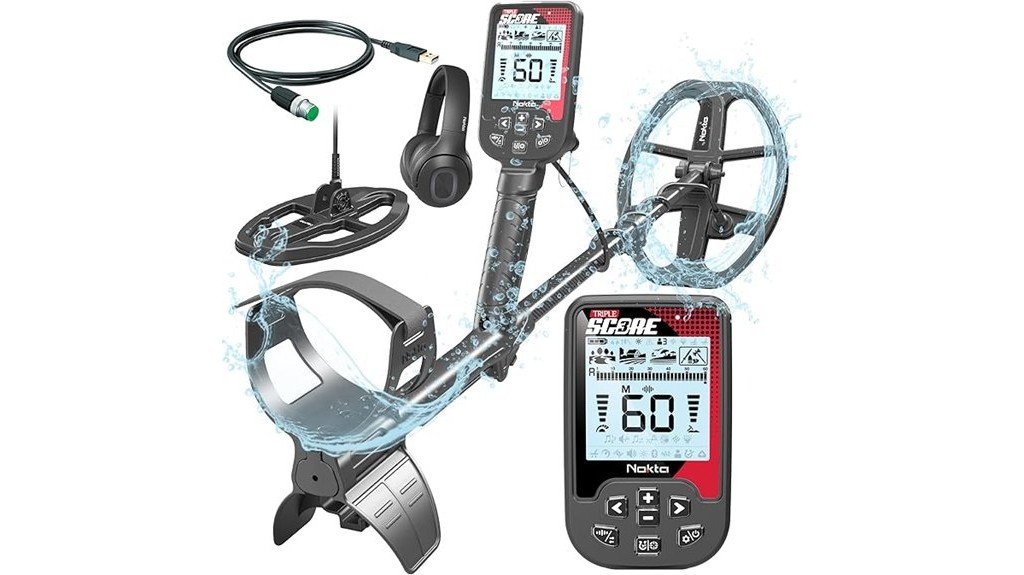
If you’re the kind of hobbyist who wants gear that can handle sand, surf, and soggy woods without breaking a sweat, the Nokta Triple Score PRO Pack is a smart pick — its fully waterproof, IP68-rated carbon fiber build lets you hunt treasures down to 16 feet, so you can follow a signal whether it’s in a puddle or under a wave. You’ll like its light 2.6 lb frame, long‑running 3250 mAh battery with USB charging, and multi‑frequency accuracy that cuts interference. Bluetooth, three search modes, and easy firmware updates mean you’ll fine‑tune recovery speed and stay in the hunt.
Best For: Enthusiast and serious hobbyist treasure hunters who want a lightweight, fully waterproof, multi-frequency detector that performs on beaches, in shallow water, and in varied terrain.
Pros:
- Fully waterproof IP68 carbon-fiber construction (submersible to 16 ft/5 m) for beach and underwater use.
- Long-lasting 3250 mAh rechargeable battery (USB) with up to 12 hours runtime and multi-frequency accuracy to reduce interference.
- Bluetooth, three search modes, and firmware updates for customization and future improvements.
Cons:
- Some reported quality-control issues and occasional defective units in reviews.
- Battery is not easily user-replaceable and may be vulnerable to heat exposure over time.
- Higher-end features may be unnecessary or complex for absolute beginners.
MINELAB MANTICORE Waterproof Multi-IQ+ Metal Detector with 11″ Double-D Coil
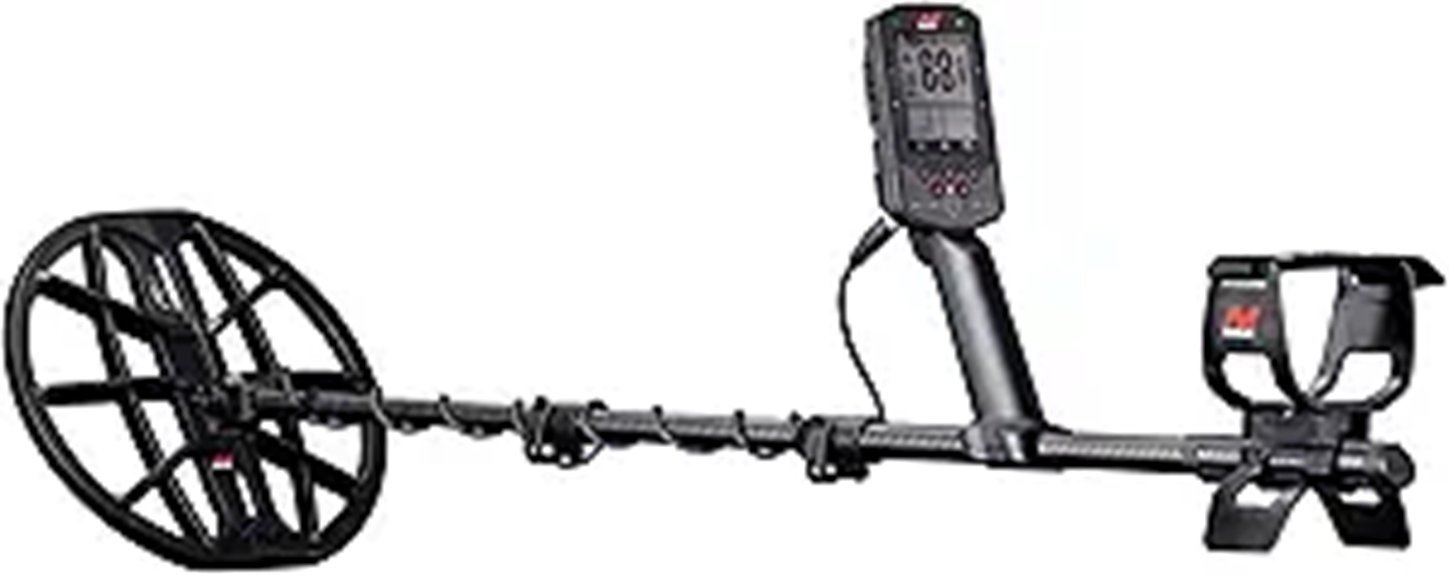
Treasure hunters who want serious power and versatility will find the MINELAB Manticore hard to beat, especially when adjustable recovery speed matters for pulling good targets out of trashy ground; I’ve used it on crowded beaches and old park sites and it consistently isolates signals that many cheaper machines smear together. You’ll appreciate Multi-IQ+ delivering 50% more power and the 11″ Double-D coil for focused coverage, while the 2D target ID and audio tweaks help you decide whether to dig. It’s lightweight, waterproof to 16 ft, runs on a lithium battery, and feels like a meaningful upgrade.
Best For: Treasure hunters and serious hobbyists who want a high-power, versatile, waterproof metal detector that excels in trashy ground and crowded beaches where adjustable recovery speed and precise target separation matter.
Pros:
- Multi-IQ+ delivers 50% more power and superior simultaneous multi-frequency performance for better target separation.
- Lightweight, collapsible design and waterproof to 16 ft (IP68) make it comfortable and versatile for beach and all-terrain use.
- Advanced 2D target ID and customizable audio options improve discrimination and help decide what to dig.
Cons:
- Higher-end features and price may be overkill for casual or beginner users on a tight budget.
- Advanced settings and customization may require time and tutorial guidance to master.
- Battery-powered operation relies on a single lithium-ion battery (included), so long outings need spare power planning.
Nokta The Legend Waterproof Metal Detector for Adults (12″ Coil, The Legend + Accupoint)
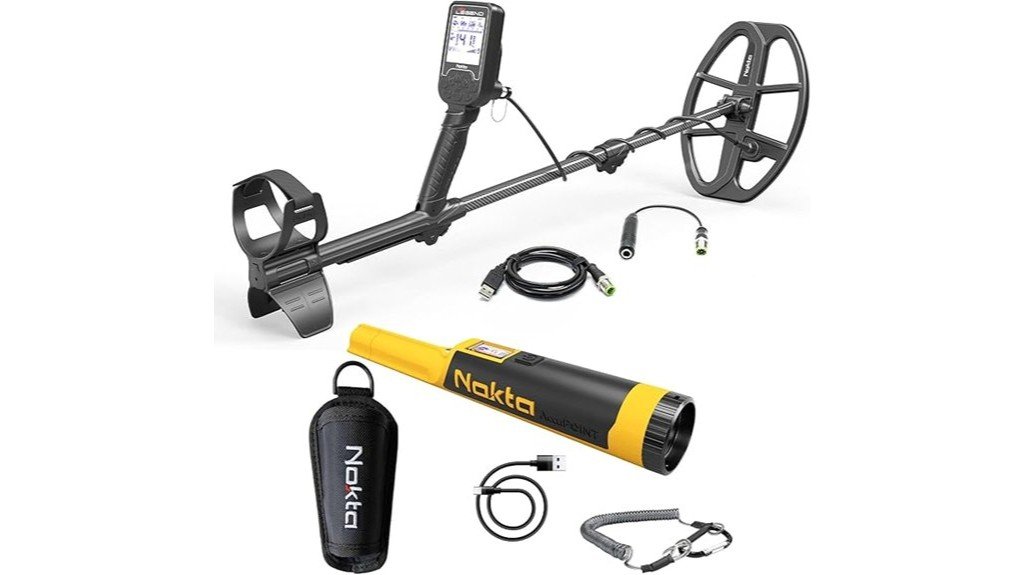
For hobbyists who want a waterproof, high-performance detector that handles both beaches and gold-bearing ground, the Nokta The Legend stands out with its first-of-its-kind simultaneous multi-frequency capability, so you’ll pick up everything from tiny nuggets to relics without constantly swapping settings. You’ll appreciate the 12″ DD coil and IP68 waterproofing to 3 meters, letting you hunt shallow water and mineralized fields with confidence, and the included Accupoint pinpointer speeds recovery. At three pounds it’s light for long days, battery lasts up to 20 hours, and users praise its ease of use—though watch for occasional quality-control issues.
Best For: Hobbyists and serious detectorists who want a waterproof, lightweight multi-frequency detector that excels on beaches, in shallow water, and in mineralized/gold-bearing ground.
Pros:
- Simultaneous multi-frequency performance picks up both tiny gold and deeper relics without frequent mode changes.
- IP68 waterproof to 3 meters with a 12″ DD coil and included Accupoint pinpointer for fast, reliable recovery.
- Lightweight (3 lb) with up to 20 hours rechargeable battery life for long detecting sessions.
Cons:
- Some users report occasional quality-control issues (e.g., dust behind the screen).
- At 12″ coil size, may be less effective for extremely deep targets compared with larger coils.
- Higher-end features and multi-frequency capability may have a learning curve for absolute beginners.
Nokta The Legend Metal Detector Professional Set with Wireless Headphones and Accupoint Pinpointer
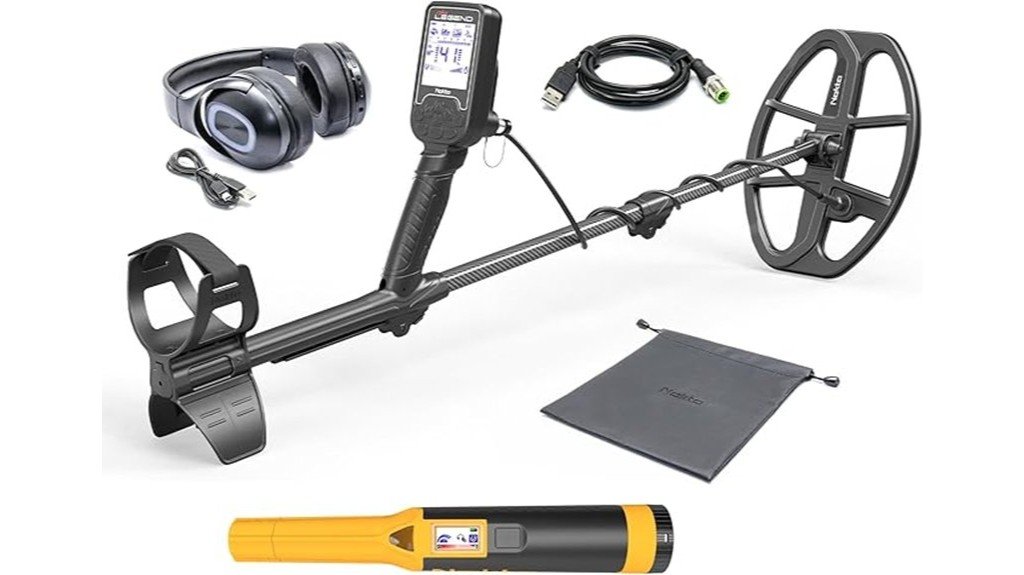
Nokta’s Legend is the best pick when you want a pro-level detector that handles everything from dry fields to shallow dives, and it especially shines if you need adjustable recovery speed to tease apart close or overlapped targets. You’ll appreciate its IP68 waterproof rating that lets you hunt down to 3 meters and shrug off dust, plus the first simultaneous multi-frequency system from Nokta, which adapts to messy ground and mixed targets. The bright color LCD keeps settings clear, and the pack includes AccuPOINT pinpointer, spare tip, belt holster, aptX low-latency headphones, USB cable, coil, flashlight, and lost-alarm.
Best For: Experienced hobbyists and pros who need a versatile, waterproof detector for fields, beaches, and shallow dives with strong multi-frequency performance and adjustable recovery for separating close targets.
Pros:
- IP68 waterproof to 3 m and dustproof, suitable for underwater and harsh environments.
- Simultaneous multi-frequency operation improves detection in mixed-ground and for varied target types.
- Includes AccuPOINT pinpointer, wireless aptX Low Latency headphones, spare tip, coil, and useful accessories (USB cable, flashlight, holster).
Cons:
- Professional feature set may have a steeper learning curve for beginners.
- Lost-alarm after 5 minutes of inactivity could trigger unintentionally in some situations.
- High-end features and accessories increase cost compared with basic detectors.
Factors to Consider When Choosing Metal Detectors With Adjustable Recovery Speed
When you’re choosing a metal detector with adjustable recovery speed, it helps to understand the basics of recovery speed and how target separation techniques and coil size affect your ability to pick out individual items, especially in trashy areas. You’ll also want to account for ground mineralization, which can throw off signals unless your machine and settings can cope, and be honest about your skill level because a more advanced unit only helps if you know how to use its features. I’ve found that starting with a mid-range detector and practicing in different soils lets you learn how recovery speed, coil choice, and technique work together before you upgrade.
Recovery Speed Basics
Although it might sound like tech jargon at first, recovery speed is one of the most practical settings you’ll use on a metal detector, and getting it right can change a slow afternoon of digging into a productive hunt, as I learned the hard way after wasting a morning on bottle caps before switching modes. Recovery speed measures how fast your detector processes signals after a target, usually in milliseconds, and lower values mean quicker reactions. You’ll want faster recovery in trashy or mineralized ground to catch nearby valuables without masking, while slower recovery can reach greater depth in open areas. Since many detectors let you adjust this, match the setting to your terrain and hunting style for much better results.
Target Separation Techniques
A good metal detector with adjustable recovery speed gives you real control over target separation, and learning how to use it can turn a frustrating search into a steady stream of finds. You’ll want faster recovery in trashy spots so the detector can bounce between signals from coins, bottle caps, and scraps without missing a valuable item tucked nearby. Practice sweeping at different speeds, listen for overlapping tones, and tighten recovery when targets cluster; I once saved a ring by switching up mid-sweep. Remember that terrain and how many objects sit in the soil matter: dense, cluttered areas need quicker response, while open fields let you slow down for depth. Choosing a detector with a wide recovery range gives you flexible tools for smarter hunting.
Ground Mineralization Effects
Because soil hides more than treasures — it holds minerals that can confuse your detector — you’ll want to understand how ground mineralization affects performance before you head out, especially if you’re hunting in riverbeds, old homesteads, or rocky fields. High mineral content creates noisy, false signals that make it hard to tell real targets from the ground, and that noise can wreck recovery speed and accuracy if you don’t compensate. You’ll benefit from detectors with adjustable recovery speed, because dialing it correctly helps filter mineral chatter while keeping coins and relics audible. Check soil composition and moisture first, or run a quick test sweep; I once swapped settings after a riverside day and immediately cut false alerts in half, which taught me to trust adjustable recovery.
Coil Size Impact
Think of the coil as the detector’s footprint: it controls how deep you can reach and how well you can pick out items that sit close together. Larger coils dig deeper and cover more ground, but they can miss tiny objects and struggle in cluttered sites; smaller coils, by contrast, give sharper target separation and better sensitivity to small finds, which I learned chasing foil and tiny rings in a crowded park. Recovery speed ties into this: slower speeds often suit larger coils, letting the detector process big, deep signals, while faster speeds work best with small coils to resolve adjacent targets quickly. Match coil size and recovery speed to your hunting spot — beach, park, or mineralized soil — for best results.
User Skill Level
How do you know which recovery speed fits your skill level and hunting goals? You’ll want to match detector settings to your experience: if you’re new, stick with slower recovery speeds so you can learn how signals behave and spot small targets more reliably, which I found helped me avoid frustration on my first few hunts. As you gain practice, start increasing speed to handle trashy parks and beaches, because faster recovery lets you separate overlapping signals and cover ground quicker. Advanced users often toggle speeds on the fly, tailoring the detector to soil, target size, and clutter, and that flexibility boosts finds. Understanding this relationship improves success and keeps detecting fun, since you’re choosing settings that suit how you hunt.
FAQ
Can Adjustable Recovery Speed Affect Battery Life Significantly?
1. Does adjustable recovery speed impact battery life?
Yes, adjustable recovery speed can significantly affect battery life.
2. How does faster recovery speed affect power consumption?
Faster recovery speeds require more power because the detector processes signals more intensively and updates more frequently.
3. What happens to battery life when using moderate recovery speeds?
Switching to moderate recovery speeds can help conserve battery life, particularly during extended hunting sessions.
4. Is it worth using faster recovery speeds for short hunts?
For short hunts, the increased power draw may be manageable, but for longer sessions, it’s advisable to use moderate speeds to save battery.
5. Can battery life be preserved by adjusting recovery speeds?
Yes, by adjusting recovery speeds to moderate or slower settings, you can effectively extend battery life during your hunts.
6. What are the trade-offs of using higher recovery speeds?
While higher recovery speeds may provide quicker signal processing, they come at the cost of increased battery drain.
7. How often should I change recovery speeds during a hunt?
You might consider changing recovery speeds based on the hunting conditions and duration to optimize battery life.
8. Are there specific scenarios where slower recovery speeds are beneficial?
Yes, in environments with less target density or during longer hunts, slower recovery speeds can be beneficial for conserving battery life.
9. Does the type of detector affect recovery speed settings?
Yes, different detectors may have varying impacts on power consumption based on their design and technology when adjusting recovery speeds.
10. How can I monitor battery life while adjusting recovery speeds?
Many detectors provide battery indicators, allowing you to monitor battery life as you adjust recovery speeds during your hunt.
Can Recovery Speed Be Adjusted Automatically by Terrain?
1. Can recovery speed be adjusted automatically in metal detectors?
Yes, some metal detectors have the capability to automatically adjust recovery speed based on the terrain and target signals.
2. How does automatic adjustment of recovery speed work?
The detector analyzes the ground conditions and the signals it receives, allowing for quicker responses in noisy environments and slower recovery in cleaner areas.
3. What are the benefits of automatic recovery speed adjustment?
Automatic adjustment improves detection efficiency by optimizing settings for various sites without the need for constant manual changes.
4. Does automatic recovery speed adjustment work in all terrains?
While many detectors can adapt to different terrains, effectiveness may vary based on the specific model and its technology.
5. Is manual tweaking still necessary with automatic adjustment?
In most cases, manual tweaking is less necessary, but users may still want to make adjustments for specific conditions or preferences.
6. Can I rely solely on automatic recovery speed adjustment?
Yes, but understanding your detector’s capabilities and the ground conditions can enhance your overall experience and results.
7. What signals trigger quicker recovery speeds?
Noisy ground conditions or multiple overlapping signals can lead to faster recovery adjustments for improved detection.
8. Are there detectors that do not have automatic adjustment features?
Yes, not all detectors come with this feature; some require manual recovery speed adjustments regardless of the terrain.
9. Does terrain type affect the effectiveness of automatic recovery speed?
Yes, different terrains can influence how effectively the detector adjusts its recovery speed, impacting overall performance.
10. What should I consider when choosing a detector with automatic adjustment?
Look for detectors with advanced technology and user reviews that highlight performance in various terrains to ensure you select a reliable model.
Do Adjustable Recovery Speeds Help in Saltwater Beaches?
1. What are adjustable recovery speeds in metal detectors?
Adjustable recovery speeds refer to the ability to change the sensitivity settings of a metal detector, allowing it to process signals from targets at different rates. This feature is particularly beneficial in challenging environments like saltwater beaches.
2. How do adjustable recovery speeds benefit beach metal detecting?
They allow users to fine-tune their detectors to filter out unwanted signals caused by mineralized salt, improving the detection of actual targets. This leads to better target separation and a more efficient recovery process.
3. Why is target separation important on saltwater beaches?
Target separation is crucial because saltwater beaches often have a high concentration of trash and mineralization. Adjustable recovery speeds enhance the detector’s ability to distinguish between valuable items and unwanted debris.
4. Can adjustable recovery speeds reduce false signals?
Yes, by tuning the detector to reject mineralized salt, adjustable recovery speeds can significantly reduce false signals. This means users can focus on real targets without being distracted by background noise.
5. What type of metal detectors have adjustable recovery speeds?
Many modern metal detectors designed for beach use come equipped with adjustable recovery speed features. It’s important to choose a model specifically designed for saltwater environments for optimal performance.
6. How do I determine the best recovery speed setting for my detector?
The best setting often depends on the specific beach conditions and personal detecting style. It’s advisable to experiment with different speeds during practice sessions to find the optimal balance between sensitivity and stability.
7. Are there any downsides to using adjustable recovery speeds?
While adjustable recovery speeds offer many benefits, setting them too high might result in missing deeper targets or smaller items. Users should find a balance that works for their detecting environment.
8. How does mineralization affect metal detecting on saltwater beaches?
Mineralization can create interference and unwanted signals, making it difficult to detect real targets. Adjustable recovery speeds help mitigate these effects by filtering out the noise.
9. Is it worth investing in a detector with adjustable recovery speeds?
Absolutely, especially for saltwater beach detecting. The ability to adjust recovery speeds enhances target detection and improves overall success rates in finding valuable items.
10. Can adjustable recovery speeds help beginners?
Yes, beginners can benefit from adjustable recovery speeds as they help simplify the detecting process by reducing false signals. This allows new users to build confidence and improve their skills more quickly.
Are There Preset Recovery Profiles for Specific Targets?
FAQs on Preset Recovery Profiles for Metal Detectors
1. What are preset recovery profiles in metal detectors?
Preset recovery profiles are built-in settings that optimize metal detectors for specific target types, such as coins, relics, or jewelry.
2. How do preset recovery profiles work?
When you select a profile, the detector automatically adjusts its recovery speed and discrimination to enhance target separation and depth for that category.
3. Can I choose a profile for different terrains?
While profiles are primarily designed for target types, some detectors may allow adjustments based on terrain, but this varies by model.
4. Are preset profiles effective for all metal types?
Yes, preset profiles are optimized for common target types, but they may not perform equally well on all metal types or in every condition.
5. Do all metal detectors come with preset recovery profiles?
No, not all models have preset profiles; it’s important to check the specifications of a detector before purchase.
6. Can I customize the recovery settings after selecting a profile?
Many detectors allow users to fine-tune settings even after selecting a preset profile, enabling greater flexibility.
7. Are preset recovery profiles beneficial for beginners?
Yes, they simplify the learning process by providing optimized settings, allowing beginners to focus on detecting rather than technical adjustments.
8. Will using a preset profile guarantee finding specific targets?
While preset profiles enhance the likelihood of finding specific targets, success also depends on factors like location, soil conditions, and user skill.
9. Can I switch profiles while detecting?
Most detectors allow you to switch profiles on-the-fly, enabling quick adjustments based on the targets you encounter.
10. How do I know which preset profile to choose?
Refer to the detector’s manual or online resources, which typically provide guidelines on which profiles work best for various target types.
Can Recovery Speed Settings Be Saved Across Sessions?
1. Can I save recovery speed settings on my detector?
Yes, many detectors allow you to save recovery speed settings for future use.
2. How do I save my recovery speed settings?
You can store your settings in user presets or profiles, which can be easily recalled later.
3. Will I need to reconfigure my settings each time?
No, by saving your settings, you avoid the need to reconfigure them for each outing.
4. Are recovery speed settings customizable?
Yes, you can customize recovery speed settings based on your preferences before saving them.
5. Can I have multiple profiles for different conditions?
Absolutely, you can create multiple profiles to suit various detecting conditions or environments.
6. Is it easy to switch between saved profiles?
Yes, switching between saved profiles is typically straightforward and quick, allowing for efficient adjustments.
7. Do all detectors support saving recovery speed settings?
Not all detectors have this feature; check your device’s manual or specifications to confirm.
8. What happens if I reset my detector?
Resetting your detector may erase saved settings, so it’s wise to back up your profiles if possible.
9. Can I modify saved recovery speed settings later?
Yes, you can modify and update your saved settings whenever needed.
10. Are saved settings retained after turning off the detector?
In most cases, saved settings are retained even after powering off the detector.
Final Thoughts
You’ve explored four amazing metal detectors that allow you to adjust recovery speed, a key feature for distinguishing targets in trashy or mineral-rich areas. When it comes to choosing between the Nokta Triple Score PRO Pack, the MINELAB MANTICORE, and the two options from Legend, it often boils down to factors like coil size, waterproof capabilities, and the degree of control you desire.
I remember a sunny Saturday spent at a bustling beach, surrounded by families and laughter, where I decided to put my detector to the test. As I shifted through the sand, I took a moment to fine-tune the settings, adjusting the recovery speed as I went along. With each beep and chirp from the machine, I became more attuned to what it was telling me. After a few adjustments, I found myself digging with renewed excitement, and to my surprise, I unearthed a rare coin that had likely been lost for decades.
So, trust your instincts, listen closely to your detector, and don’t hesitate to experiment with settings. You never know what treasures await you just beneath the surface.