
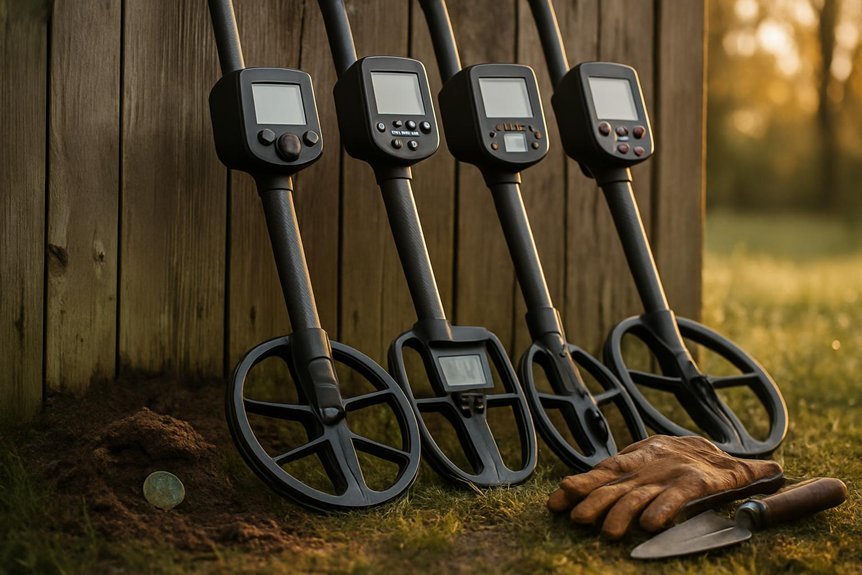
If you’re ready to hunt for coins, buttons, and old bits of history, you’ll want a detector that’s reliable, easy to use, and tuned for relics; I’ve tested models that fit beginners and serious hobbyists alike, and I’ll walk you through why the Garrett ACE 300, Nokta Triple Score PRO Pack, MINELAB X-Terra Elite Expedition, and Bounty Hunter TK4 Tracker IV stand out, how they handle soil, depth, and discrimination, and which one matches your budget and style—so keep your gloves handy, because the next find could be just below the surface.
Garrett ACE 300 Metal Detector for Adults with Waterproof Coil and Headphones
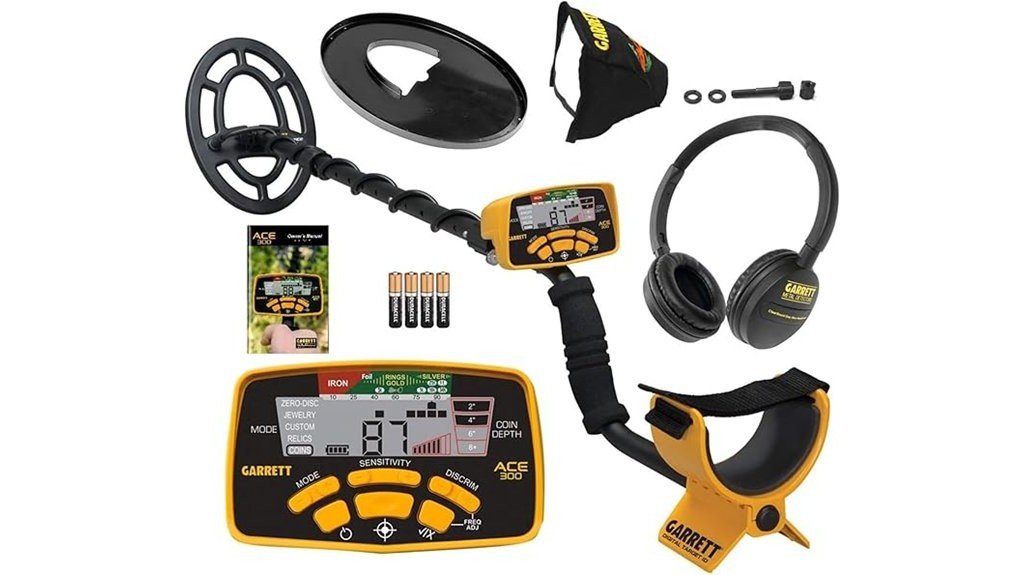
If you’re an adult getting serious about relic hunting, the Garrett ACE 300 is a smart pick because it pairs precise digital Target ID with a waterproof coil and comfortable headphones, so you can spend more time finding and less time guessing; you’ll like the numeric 0–99 readout that tells you what metal conductivity to expect, and the improved iron resolution helps separate coins or buttons from junk. You get electronic pinpointing for exact digs, adjustable frequency to cut interference, and ClearSound headphones plus covers. I’ve used one in wet fields—its coil stayed reliable and saved me hours.
Best For: Adults getting serious about relic and coin hunting who want a reliable, easy-to-read detector with waterproof capability and comfortable headphones.
Pros:
- Digital Target ID (0–99) and improved iron resolution make identifying valuable targets easier and reduce time spent on junk.
- Waterproof coil and included searchcoil cover enable hunting in wet conditions without worry.
- Electronic pinpointing, adjustable frequency, and ClearSound headphones improve accuracy and reduce interference and distractions.
Cons:
- May lack advanced features found on higher-end models (e.g., multi-frequency simultaneous operation).
- Designed for adults—size and ergonomics may not suit younger or much shorter users without adjustment.
- Included accessories are basic; serious users might want to upgrade headphones or add additional coils.
Nokta Triple Score PRO Pack Metal Detector for Adults
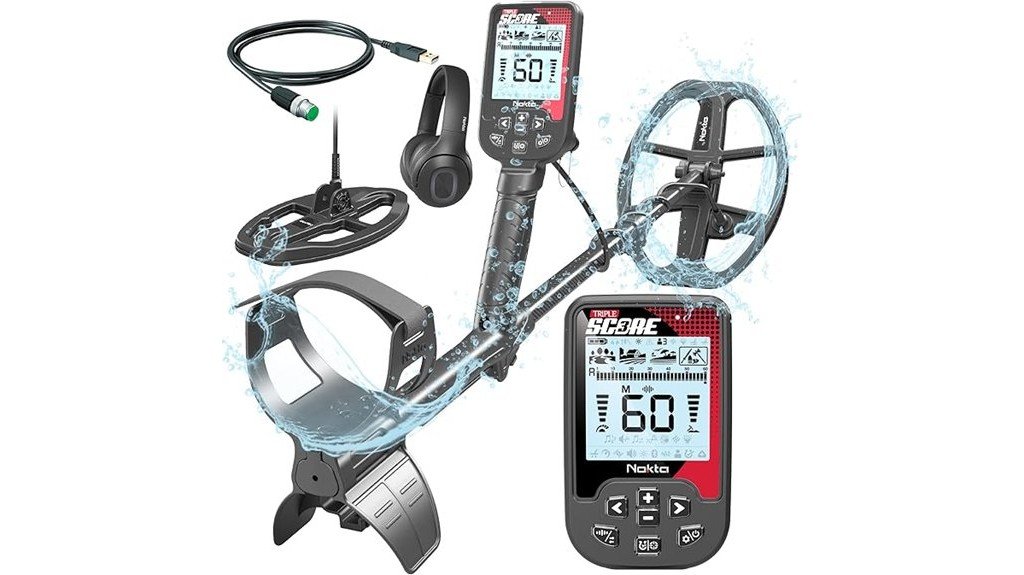
For hobbyists who want a single machine that can handle beaches, parks, and shallow dives, the Nokta Triple Score PRO Pack stands out thanks to its fully waterproof, multi-frequency design and long-lasting rechargeable battery; you’ll appreciate that it’s light enough for hours of searching yet rugged enough to take underwater to 5 meters. You’ll like the 2.6 lb carbon fiber build, three search modes, and Bluetooth connectivity that pairs with apps for mapping finds, and the 12-hour USB-rechargeable battery keeps you hunting. Beginners and pros praise accuracy and comfort, though watch for occasional quality-control and battery-access issues.
Best For: Hobbyists and serious treasure hunters who want a lightweight, fully waterproof, multi-frequency metal detector that works on beaches, parks, and shallow dives.
Pros:
- Fully waterproof (IP68 to 5 m) and lightweight carbon-fiber build (2.6 lb) for comfortable use in varied environments.
- Multi-frequency precision, three search modes, and Bluetooth connectivity for app integration and better target ID.
- Long-lasting 3250 mAh USB-rechargeable battery (up to ~12 hours) with included extra coil and headphones.
Cons:
- Some users report occasional quality-control issues and defective units.
- Battery is not easily user-replaceable and may suffer from heat exposure concerns over time.
- Limited long-term battery lifespan (300–500 charge cycles) could require attention for heavy users.
MINELAB X-Terra Elite Expedition Metal Detector (Waterproof, Multi-IQ)
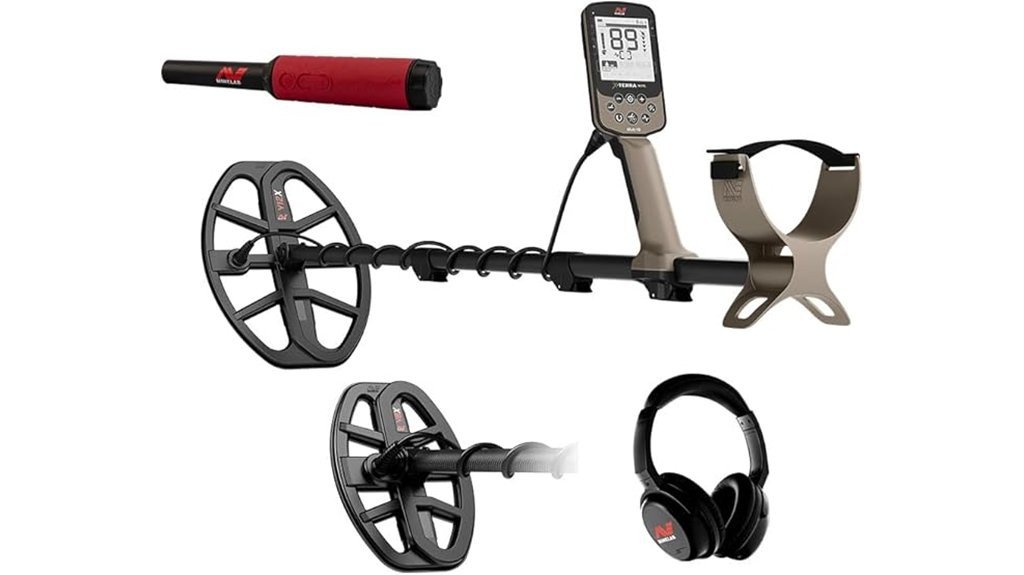
Adventure seekers and beachcombers will love the MINELAB X-Terra Elite Expedition because its Multi-IQ multi-frequency tech lets you hunt across different soils and waters with confidence, making it a top pick when you’re after relics in varied conditions. You get waterproofing to 16 ft, two coils for wide and pinpoint searching, and a PRO-FIND 40 pinpointer that quickly zeros in on finds without interference. The 119 Target IDs and all-tone audio help you tell trash from treasure, and users praise its light weight and saltwater performance. Expect a short learning curve for ground balancing, then more finds.
Best For: Adventure seekers and beachcombers who want a lightweight, waterproof multi-frequency detector for hunting relics and coins across varied soils and saltwater.
Pros:
- Multi-IQ multi-frequency tech and 119 Target IDs for accurate detection across different ground conditions.
- Waterproof to 16 ft with two coils and PRO-FIND 40 pinpointer for versatile beach and underwater use.
- Lightweight design and strong saltwater performance with clear all-tone audio feedback.
Cons:
- Short learning curve required for effective ground balancing and advanced settings.
- Battery is a single included lithium-ion cell—spares may be needed for extended trips.
- Higher-end features may be unnecessary for casual hobbyists seeking a simple detector.
Bounty Hunter TK4 Tracker IV Metal Detector for Gold, Silver, Coins & Relics
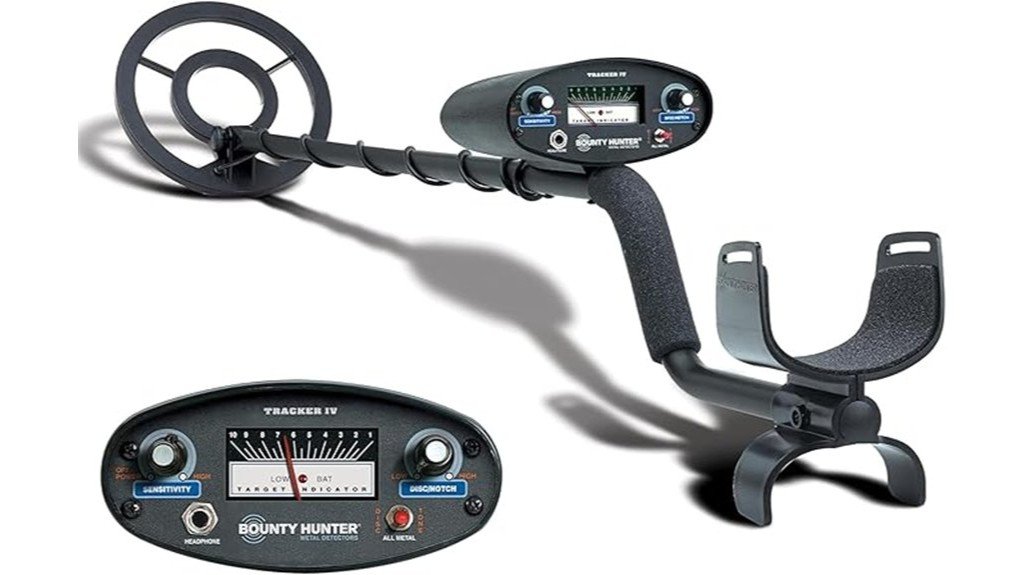
The Bounty Hunter TK4 Tracker IV is a great pick when you want a rugged, no-frills detector that’s easy to learn and built for everyday relic hunting, whether you’re teaching a kid the ropes or chasing coins at the local park. You’ll appreciate three detection modes — all-metal, tone, and discrimination — that help you ignore trash while zeroing in on silver, jewelry, and old relics. It’s lightweight, made in the USA, and runs on batteries with simple analog controls and adjustable sensitivity. The 8-inch waterproof coil lets you hunt shallow water and beaches, and it pairs well with pinpointers.
Best For: beginners and hobbyists (including kids) who want a lightweight, rugged, easy-to-use metal detector for coins, jewelry, and relics in parks, beaches, and shallow water.
Pros:
- Simple analog controls with adjustable sensitivity make it beginner-friendly.
- Three detection modes (all-metal, tone, discrimination) help filter trash and target coins, silver, and relics.
- 8-inch waterproof search coil and battery-powered portability suit beach and shallow-water hunting.
Cons:
- Basic feature set may lack advanced target ID and discrimination found on higher-end units.
- Analog interface offers fewer precision options for experienced detectors compared to digital models.
- Reliance on batteries can mean frequent replacements during extended use.
Factors to Consider When Choosing Metal Detectors for Relics
When you’re choosing a metal detector for relic hunting, you’ll want to weigh a few key features that really change your success rate, like how deep it can detect, how well it tells targets apart, and how it handles mineralized ground. Think about coil type and size too, since a larger coil covers more ground but a smaller one can pinpoint better, and don’t forget frequency—single vs. multi-frequency affects sensitivity to different metals. I’ve learned from hours in the field that matching these factors to your local soil and the kinds of relics you’re after makes all the difference, and I’ll walk you through each so you can pick the right tool.
Detection Depth Capability
Detection depth matters a lot when you’re hunting for relics, because how deep a detector can sense an object will often decide whether you walk away with a cool find or an empty pocket. You’ll find most detectors locate items about 6 to 12 inches down, but soil, moisture, and the object’s size change that number, so pick gear that matches where you hunt. Multi-frequency models can push depth by reducing interference in tricky ground, and ground balance controls keep mineralized soil from masking deeper targets. Larger coils reach farther but can miss tiny relics, so I usually carry two coils—one big for depth and one small for detail. Think about terrain and coil choice, and you’ll improve your chances.
Target Identification Accuracy
Because you’ll often be digging in trash before you hit treasure, target identification accuracy matters as much as raw depth, and it’s what helps you tell a Civil War button from a rusty nail without tearing up the whole field. You want a detector that gives clear signals, whether through a numeric digital ID scale or distinct audio tones, so you can decide fast and waste less time. Look for models with wide ID ranges — 119-plus values can narrow guesses — and strong discrimination to filter iron and other junk. Multi-frequency tech boosts accuracy by sensing different metals at once, and good audio feedback lets you keep your eyes on the sweep while trusting the sound. I’ve learned to rely on precise IDs; they save sweat and smiles.
Ground Balancing Performance
Ground balancing is the unsung hero of relic hunting, and getting it right can mean the difference between digging up a Civil War button and digging up nothing but frustration; I’ve stood on fields where the soil was so mineral-rich the detector chirped like a bird, and only a well-balanced machine let me hear the real targets. You’ll want a detector that cancels soil mineralization so weak relic signals aren’t buried in noise, and adjustable ground balance lets you fine-tune for clay, salt, or iron-rich soils. Auto ground balance helps you focus on hunting, while a lock feature keeps a steady setting in uniform ground. Advanced systems give you the edge in highly mineralized sites where deeper relics hide.
Coil Type and Size
Once you’ve got ground balance set so your detector isn’t singing like a bird in mineral-rich soil, the coil you choose becomes the next big player in how many relics you’ll actually find. Pick a larger coil and you’ll reach deeper targets across wide-open fields, but expect less finesse for tiny buttons or thin coins; I remember swapping to a small coil in a park and suddenly pulling up delicate lead tags I’d missed before. Concentric coils help separate valuable targets from trash in cluttered sites, while double-D or wide-scan coils speed you across acres. Don’t forget waterproof coils if you hunt riverbanks or beaches, and match coil size and shape to the terrain and target types so you get the best balance of depth, sensitivity, and target isolation.
Frequency and Multi-Frequency
While you’ll already have coil choice and ground balance sorted, the frequency your detector runs on can make the difference between digging up a dull bottle cap and uncovering a neat old relic, so it’s worth paying close attention; I’ve learned this the hard way after switching from a low-frequency machine that missed tiny lead buttons to a higher-frequency unit that suddenly started singing over every small target in the park. You’ll find low frequencies (3–7 kHz) penetrate deeper and suit larger or buried relics, while high frequencies (10+kHz) pick up small coins and delicate artifacts with finer target separation. Multi-frequency models run several bands at once, improving detection in mixed soils and letting you tune performance for depth, discrimination, and mineralized beaches.
Portability and Weight
Frequency makes a big difference in what you’ll hear through the headphones, but once you’ve settled on the right band, portability and weight become the factors that determine how long you can actually hunt without your arms quitting on you. You’ll want a detector around 2.5 to 3 lbs for the best balance between performance and comfort, light enough to swing for hours yet solid enough to handle rocks and roots. Look for compact, collapsible designs that tuck into a car or backpack when you travel between sites, and check how the shaft and coil fold — I once hiked miles with a bulky unit and swore I’d never repeat it. Finally, pick a well-balanced model to reduce wrist strain and keep you searching longer.
Battery Life and Charging
Because a long day in the field can turn into a disappointing short one if your detector dies, battery life and charging should be near the top of your checklist; look for models that give 8–12 hours per charge so you can cover big sites without scrambling for a spare. You’ll want rechargeable Lithium Polymer packs where possible, since they last hundreds of cycles and save money and waste over time, and lighter batteries reduce arm and back fatigue during long hunts. Check for USB charging so you can juice up from a power bank or car, and make sure the battery compartment is easy to access — I once missed a promising dig because I couldn’t swap a sealed pack quickly. Small design choices like these make long days far more productive.
FAQ
Can Metal Detecting Damage Archaeological Sites Legally?
1. Can I legally metal detect on archaeological sites?
No, metal detecting on archaeological sites typically requires permits. Always check local laws to avoid legal issues.
2. What are the consequences of metal detecting without permission?
Digging without authorization can lead to legal penalties, including fines or confiscation of equipment. It also damages the archaeological context.
3. How does unauthorized digging harm archaeological sites?
Unauthorized digging removes artifacts and disrupts soil layers, which can erase valuable historical context and information.
4. Are there specific laws governing metal detecting?
Yes, laws vary by location and often include regulations on permits, protected sites, and the handling of discovered items. Always research local statutes.
5. What should I do if I find an artifact while metal detecting?
If you discover a significant artifact, report it to local authorities or a heritage organization. Proper documentation is crucial for preservation.
6. How can I obtain permission for metal detecting?
To get permission, contact landowners or local archaeological authorities. Be prepared to explain your intentions and follow their guidelines.
7. What are the penalties for damaging archaeological sites?
Penalties can include fines, legal action, and restoration costs. Additionally, it may result in the loss of access to future detection opportunities.
8. Is it necessary to record my findings while metal detecting?
Yes, documenting your finds helps preserve the historical record. It is essential for both ethical metal detecting and legal compliance.
9. What constitutes significant discoveries in metal detecting?
Significant discoveries often include rare artifacts, items of historical importance, or those that contribute to understanding a site’s context.
10. Can I keep artifacts I find while metal detecting?
Keeping artifacts depends on local laws and the nature of the find. Many jurisdictions require reporting significant finds, while others may allow personal retention under certain conditions.
Do Detectors Interfere With Underground Utilities or Pipelines?
FAQs on Detectors and Underground Utilities
1. Do detectors interfere with underground utilities?
Detectors generally do not interfere with underground utilities, but they may cause brief electromagnetic interference.
2. What kind of interference can detectors produce?
Detectors can produce brief electromagnetic interference that may affect sensitive sensors used by some utility systems.
3. Is it safe to use detectors near utility corridors?
It is advisable to avoid known utility corridors when using detectors to prevent any potential issues.
4. How can I locate underground utilities before digging?
Consulting local utility maps is an effective way to identify the location of underground utilities before starting any digging project.
5. Should I contact utilities before using detectors?
Yes, it is recommended to call local utility companies before digging to ensure the safety of pipes and monitoring equipment.
6. What happens if I damage underground utilities while digging?
Damaging underground utilities can lead to service disruptions, safety hazards, and potential legal liabilities.
7. Are there specific detectors designed for utility detection?
Yes, some detectors are specifically designed to locate underground utilities and can help minimize risk.
8. How can I ensure the safety of sensitive sensors near detectors?
Maintaining a safe distance from sensitive sensors and using appropriate detection methods can help mitigate interference risks.
9. What precautions should I take when working near utilities?
Always mark the area, consult utility maps, and use caution when working in proximity to known utility lines.
10. Can electromagnetic interference from detectors cause false readings?
Yes, electromagnetic interference can potentially lead to false readings on sensitive equipment, so it’s important to monitor the environment closely.
11. What should I do if I suspect I’ve interfered with utility sensors?
If you suspect interference with utility sensors, contact the utility company immediately to report the issue and seek guidance.
Can I Detect Relics Through Brick or Concrete Structures?
1. Can I detect relics through brick structures?
Yes, relics can be detected through thin brick, but the detection range decreases.
2. Is it possible to detect relics through concrete?
Yes, thin concrete allows for detection, though thicker concrete may hinder signal reception.
3. What type of metal detector should I use for detecting through structures?
A powerful metal detector with low frequency is recommended for deeper penetration through materials.
4. How important is ground balancing when detecting through brick or concrete?
Ground balancing is crucial as it helps optimize the detector’s performance and improves signal clarity.
5. Does the thickness of the structure affect detection?
Yes, thicker or reinforced structures can significantly block signals, making detection more challenging.
6. What should I consider if I want to detect relics in urban environments?
Be prepared for potential interference from various structures and select a suitable detector for the conditions.
7. How can I improve my chances of detecting relics through barriers?
Using a high-quality detector, adjusting settings for the specific material, and practicing patience can enhance your results.
8. Are there specific detection techniques for brick and concrete?
Employing a slow and methodical scanning technique can help pick up faint signals that may be masked by the material.
9. Will weather conditions affect relic detection through structures?
Yes, extreme weather can influence signal strength, so it’s best to choose optimal conditions for detecting.
10. Can I detect relics if the structure is very thick?
Detection through very thick structures is often impractical, as most detectors will struggle to penetrate effectively.
Are There Insurance or Liability Considerations for Hobby Detecting?
FAQs on Insurance and Liability for Hobby Detecting
1. Do I need insurance for hobby detecting?
Yes, it is advisable to obtain hobbyist insurance to protect yourself from potential liability claims while detecting.
2. What type of permission do I need for detecting on private land?
You must obtain explicit permission from landowners before detecting on their property to avoid legal issues related to trespassing.
3. Are there specific laws I should be aware of regarding treasure hunting?
Yes, familiarize yourself with local treasure laws, as they can dictate how you can legally search for and keep found items.
4. How can I document my finds effectively?
Keep a detailed log of your finds, including location, date, and descriptions, to establish ownership and comply with local laws.
5. What should I do to prevent trespassing issues?
Always seek permission before entering private property and respect posted signs or barriers to avoid legal complications.
6. Is it necessary to have a liability waiver?
While not always required, a liability waiver can provide an additional layer of protection for both you and the landowner.
7. Will my homeowner’s insurance cover hobby detecting activities?
Check with your homeowner’s insurance provider, as coverage for hobby detecting may vary and might not be included.
8. What risks should I be aware of while hobby detecting?
Risks include potential injuries, property damage, and legal ramifications if you do not secure permission or comply with local laws.
9. How can I protect myself from potential legal issues?
Stay informed about local laws, document your activities, and ensure you have appropriate insurance to cover any potential liabilities.
10. What should I do if I find something valuable?
Report valuable finds according to local treasure laws, and consult with a legal expert if you’re unsure about the ownership and legal rights associated with your discovery.
How Can I Verify a Relic’s Historical Authenticity?
1. What is provenance in the context of relic authentication?
Provenance refers to the history of ownership and documentation of a relic. By tracing its origins, you can establish its legitimacy and historical significance.
2. How can experts assist in verifying a relic’s authenticity?
Consulting experts or museums provides access to specialized knowledge and resources. They can offer valuable insights and assessments based on their experience with similar objects.
3. What types of scientific testing are used for relic verification?
Professional conservation and scientific testing, such as X-ray and metallography, help analyze the materials and construction of a relic. These tests can identify inconsistencies that may suggest a forgery.
4. Why is it important to compare known typologies?
Comparing a relic to established typologies allows you to identify characteristics that confirm its authenticity. This includes examining style, craftsmanship, and materials typical of the period in question.
5. What role does documentation play in verifying a relic?
Documenting findings from research, expert consultations, and scientific tests creates a comprehensive record. This evidence is crucial for confirming or challenging the historical claim of the relic.
6. Can I verify a relic’s authenticity on my own?
While individual research can provide insights, it is often best to involve experts for a thorough assessment. Their expertise is essential for accurate verification.
7. What is metallography, and how does it help in authentication?
Metallography is the study of metal’s structure through microscopic examination. This technique can reveal details about the metal’s composition and manufacturing processes, aiding in authenticity verification.
8. How can provenance help in identifying forgeries?
A well-documented provenance can expose gaps or inconsistencies in a relic’s history, which may indicate forgery. If a relic lacks credible provenance, its authenticity is more likely to be questioned.
9. What should I do if I suspect a relic is a forgery?
If you suspect a relic is a forgery, gather all available documentation and consult with experts for a detailed examination. They can conduct scientific testing and provide an informed opinion.
10. Is the historical claim of a relic always definitive?
No, historical claims can often be contested or re-evaluated based on new evidence or findings. Continuous research and advancements in testing methods can alter our understanding of a relic’s authenticity.
Final Thoughts
Imagine standing on a sunlit field, the excitement buzzing in the air as you prepare for a day of relic hunting. You’ve got four solid metal detector options to choose from, each tailored to different skill levels and varied terrains. It’s like picking out the perfect tool for your treasure quest—one that aligns with your personal goals and budget. I remember the thrill of unearthing a Civil War button with just a basic detector, a moment that taught me never to underestimate beginner gear.
The Garrett detector stands out for its reliability; it’s like the trusty old friend you can always count on. Then there’s Nokta, with its impressive multi-frequency versatility—imagine being able to tune into different signals, much like adjusting the dial on an old radio to catch your favorite station. Minelab is known for its depth capabilities, almost like having a sixth sense for where the good stuff lies buried. And for those just starting out, Bounty Hunter offers a user-friendly experience; it’s as if it holds your hand through the learning process, making it easier to dive into this exciting hobby.
As you make your choice, think about the coil size, discrimination features, ground balance, and how comfortable it feels in your hands. Each detail can make a difference in your adventure. So, grab your gear, head out, and let the thrill of discovery guide you as you start digging into history.