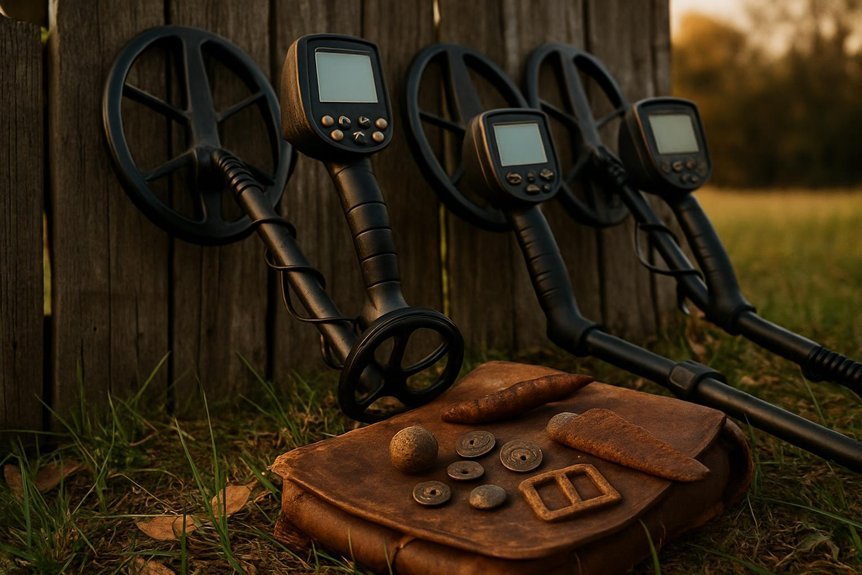
If you’re serious about hunting Civil War relics, you’ll want a detector that’s precise, rugged, and easy to tune in changing soil—I’ve spent weekends testing sites where one pass turned up a musket ball and another found nothing. You’ll see four top picks here, each with strengths for different soil, depth, and budget needs, plus tips on coils, discrimination, and legal digs that’ll help you choose the right tool for your next field session.
MINELAB MANTICORE Waterproof Metal Detector with 11″ Double-D Coil
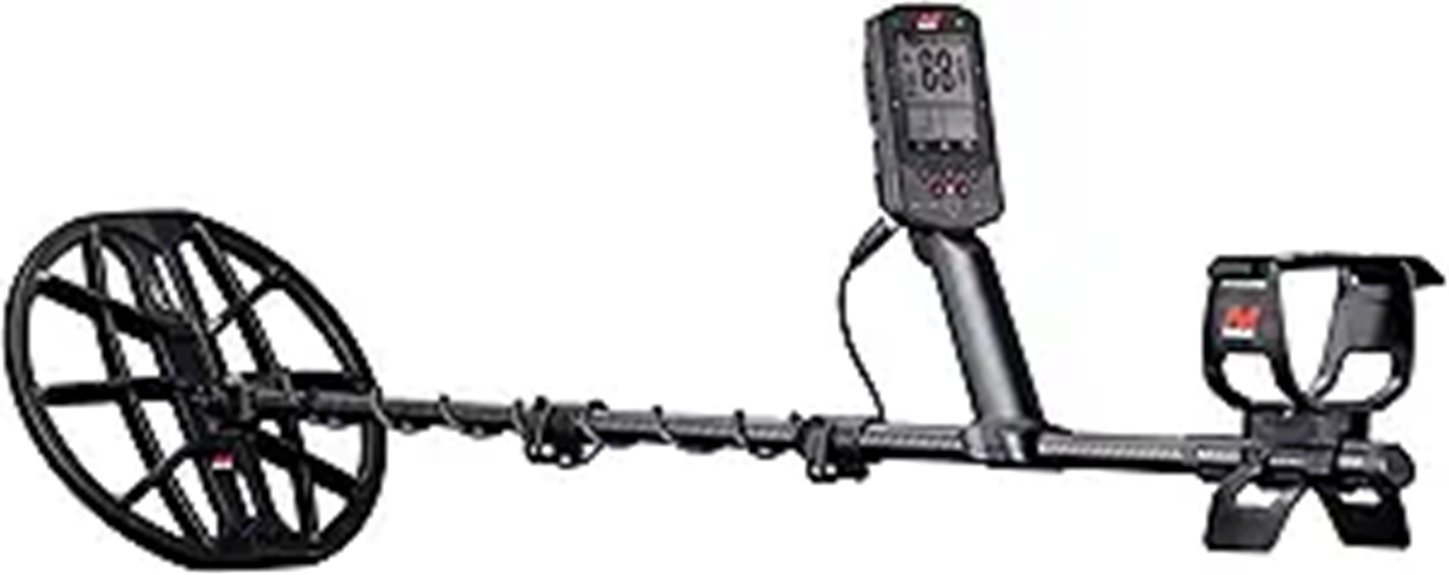
If you’re serious about finding Civil War relics and want a detector that handles everything from shallow buttons to deeper bullets, the MINELAB Manticore is a top pick thanks to its Multi‑IQ+ power, which gives you the strongest simultaneous multi-frequency performance on the market; I’ve taken similar high‑end detectors out into old fields, and the extra power consistently helped pull faint, rusted targets away from cluttered ground. You’ll get a lightweight, waterproof unit with an 11″ Double‑D coil, rich audio controls, and an easy menu, so you can hunt longer, dig smarter, and separate real relics from trash.
Best For: Experienced hobbyists and serious relic hunters who want a high-power, waterproof multi-frequency detector for locating a wide range of targets from shallow Civil War buttons to deeper bullets.
Pros:
- Multi-IQ+ delivers very strong simultaneous multi-frequency performance for better detection of faint, rusted targets.
- Lightweight, waterproof design (to 16 ft) with collapsible shaft and 11″ Double-D coil for comfortable, all-terrain use.
- Advanced 2D target ID and rich audio/customizable settings make target discrimination and learning curve easier.
Cons:
- Higher price point than entry-level detectors, so a larger upfront investment is required.
- Advanced features and settings may require watching tutorials or practice to optimize for specific sites.
- Battery is rechargeable but reliance on a single included lithium-ion pack means carrying spares for long field sessions.
Minelab X-Terra Elite Expedition Metal Detector with Coils, Headphones, Charging Cable & PRO-FIND 40 Pinpointer
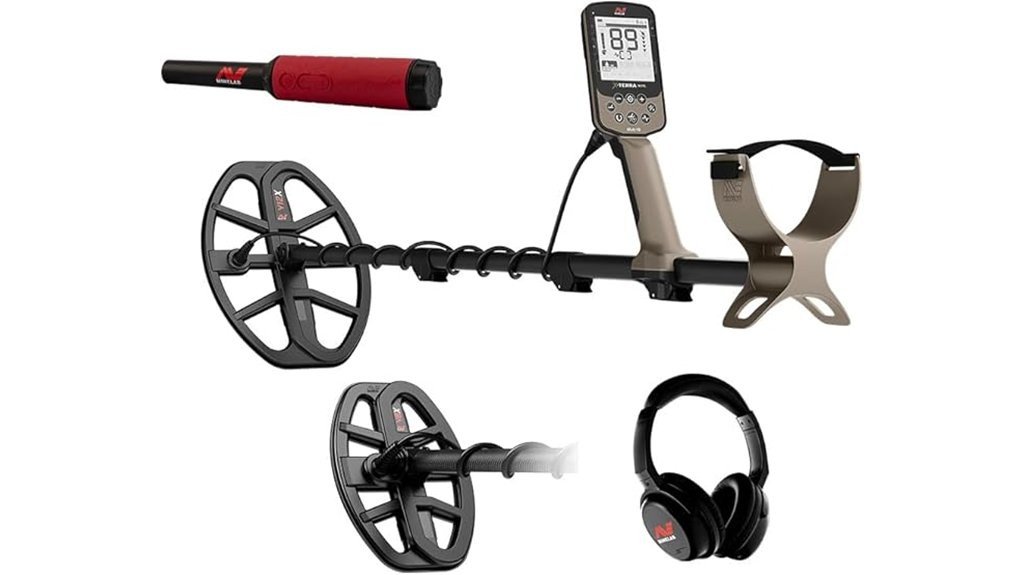
For relic hunters who want a single, versatile machine that handles beach dives and dry-field digs with equal confidence, the Minelab X-Terra Elite Expedition stands out thanks to its Multi-IQ multi-frequency system and waterproof build, which let you hunt saltwater shorelines and shallow wreck sites without swapping gear. You’ll appreciate the included V8X and V12X coils, ML85 headphones, and PRO-FIND 40 pinpointer, all packed into a lightweight 1.3 kg frame. With 119 target IDs, all-tone audio, and 16 ft submersion rating, it balances power and ease; expect a short learning curve, then reliable relic finds.
Best For: Relic hunters and beach/shoreline divers who want a versatile, lightweight metal detector that performs well in both saltwater and dry-field conditions.
Pros:
- Multi-IQ multi-frequency technology and 119 target IDs improve detection accuracy across varied ground and saltwater conditions.
- Waterproof to 16 ft (5 m) with included V8X and V12X coils and PRO-FIND 40 pinpointer for complete beach and shallow-water hunting setups.
- Lightweight (1.3 kg) and includes ML85 headphones and rechargeable battery for comfortable, ready-to-use outings.
Cons:
- Some users report a short learning curve for optimal settings and ground balancing, requiring time to master.
- Higher-end features and accessories may put it above entry-level budgets.
- Warranty handled through manufacturer—service experience may vary by region.
Garrett ACE 300 Metal Detector for Adults
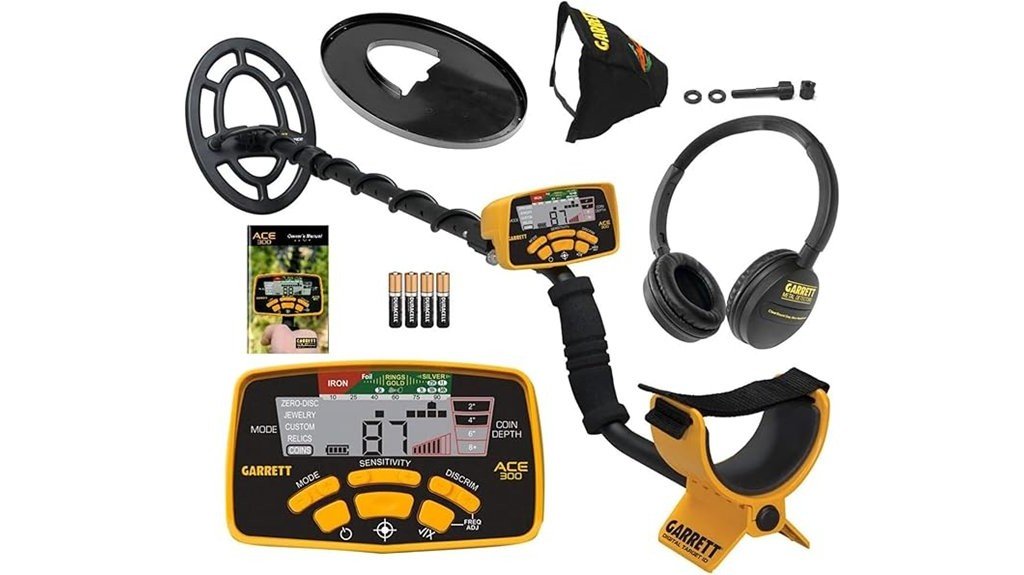
Hunting for Civil War relics, you’ll appreciate the Garrett ACE 300 because it’s built for adults who want clear, dependable target information without fuss, and its numeric Digital Target ID (0–99) helps you tell promising finds from junk before you start digging. You’ll like the improved iron resolution that separates nails from coins more reliably, and the waterproof coil plus included headphones mean you can work wetter sites without extra gear. Use electronic pinpointing in all-metal mode to zero in fast, and switch the adjustable frequency when other detectors crowd the park; it’s simple, precise, and feels sturdy in your hands.
Best For: Adults seeking a dependable, easy-to-read metal detector for relic and coin hunting with clear target ID and waterproof capability.
Pros:
- Numeric Digital Target ID (0–99) provides precise conductivity readings to help identify promising targets before digging.
- Improved iron resolution reduces false positives from nails and iron trash, improving find quality.
- Waterproof coil and included headphones allow searching in wet conditions without extra purchases.
Cons:
- Designed for adults only, may not be comfortable or adjustable enough for younger or much smaller users.
- Advanced users might find features limited compared with higher-end models (e.g., fewer specialized search modes).
- Included accessories like environmental cover-up and coil cover are basic; serious users may want more protective or premium gear.
Nokta Triple Score PRO Pack Metal Detector for Adults
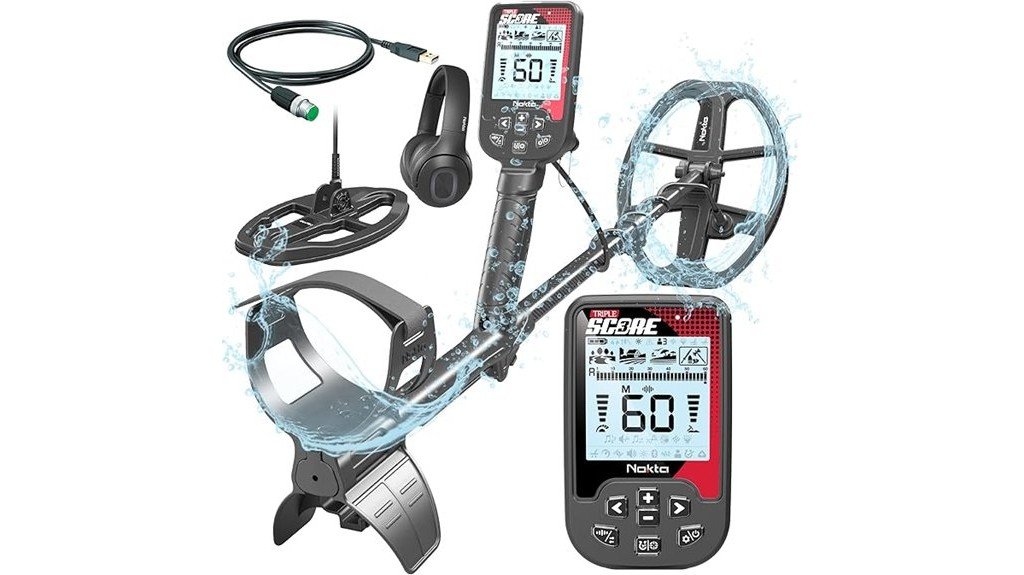
The Nokta Triple Score PRO Pack is a smart pick for any relic hunter who wants a rugged, all‑around detector that won’t quit when the terrain gets tough; its fully waterproof IP68 design and multi‑frequency precision make it just as happy scanning a muddy Civil War campsite as it is probing a shallow stream. You’ll appreciate the 2.6 lb carbon fiber build and 12‑hour USB‑rechargeable battery, which keep you hunting longer without arm fatigue, and Bluetooth plus firmware updates mean the detector grows with you. It’s accurate, beginner‑friendly, and comes with extra coil and headphones, though watch battery access reports.
Best For: hobbyist and serious treasure hunters who want a lightweight, fully waterproof, multi-frequency detector that performs across beaches, fields, and shallow water.
Pros:
- Fully waterproof IP68 design with multi-frequency accuracy for reliable detecting in varied environments.
- Lightweight 2.6 lb carbon fiber build and 12‑hour USB‑rechargeable battery for comfortable extended use.
- Bluetooth connectivity and firmware updates for feature growth and improved usability.
Cons:
- Reports of quality control and occasional defective units.
- Battery access/replacement concerns and sensitivity to heat exposure over time.
- Limited long-term battery lifespan (300–500 charge cycles) may require eventual replacement.
Factors to Consider When Choosing Metal Detectors for Civil War Relics
When you’re hunting for Civil War relics, you’ll want a detector that reaches the right depth, lets you pick the best frequencies, and can tell junk from treasure without missing fragile finds. Pay attention to how well it balances with different soils, and choose coil sizes and shapes that match the kind of search you do—I’ve found smaller coils work better in tight, root-filled spots while larger coils cover ground faster. These choices together decide whether you walk away with a handful of bottle caps or a real piece of history, so it’s worth weighing each factor carefully.
Detection Depth Capability
Because Civil War relics are often buried deeper than modern trash, you’ll want to pay close attention to a detector’s stated depth capability, since that’s what determines whether a musket ball or a uniform button shows up as a blip or stays stubbornly silent below your coil. Depth varies a lot between models; high-performance units can reach 12 inches or more, which is often enough for deeper relics. Coil size matters—bigger coils find depth but can miss tiny targets, so I usually carry a large coil for depth and a small one for buttons. Soil minerals can cut effective depth, so choose a detector with ground-adjust features or multi-frequency tech to keep targets clear. Practice with your settings to learn real-world depth.
Frequency Selection Options
If you want to pull up both deep musket balls and tiny uniform buttons without switching machines every five minutes, picking the right frequency—or a detector that uses several at once—matters a lot, and you’ll thank yourself once you start digging. Lower frequencies around 5–10 kHz reach deeper and suit large, buried Civil War relics, while higher frequencies above 15 kHz pick up small targets like buttons and tiny buckles with greater sensitivity. Multi-frequency machines give you both benefits at once, letting you adapt as the terrain or finds change. Also consider soil mineralization: some frequencies handle mineralized ground better, so choose a detector whose frequency options match your site’s conditions.
Discrimination and Sensitivity
Good discrimination and sensible sensitivity settings are two of the single most important tools you’ll use in the field, because they let you separate the exciting finds from the everyday trash and decide quickly whether a beep is worth digging. You’ll want a detector that filters common junk like pull-tabs while letting through older iron or lead pieces, and numerical ID or varied audio tones give you clues before you dig. Crank sensitivity up to catch small buttons or deep bullets, but expect more chatter from bottle caps, so learn to balance it for each site. Multi-frequency machines help you pick up diverse Civil War metals, and practicing with target ID builds the instincts that turn noise into history.
Ground Balance Performance
When you’re hunting Civil War relics in fields that have sat for a century or more, ground balance becomes one of your most important tools, because mineralized soil can mask or mimic the signals from iron buttons, bullets, and buckles; a detector that lets you adjust or automatically compensate for those minerals will help you separate real targets from annoying false signals. You’ll want a detector with adjustable ground balance so you can match it to chalky, clay, or iron-rich soils, and many models offer automatic balancing that adapts as you sweep. Learning to fine-tune or lock the setting will boost your recovery rate, and once you get the hang of it—trust me—you’ll dig fewer junk signals and more history.
Coil Size and Shape
Because the size and shape of your search coil change how a detector “sees” the ground, choosing the right one can make the difference between finding a neat buckle and scooping up a handful of iron nails, so you’ll want to evaluate depth, target separation, and how easy the coil is to swing during a long day in the field. You’ll usually pick a 10–12 inch coil for Civil War relics because it balances depth and the ability to separate close targets, letting you detect a button near a nail. Elliptical coils slip through brush and tight spots better, while round coils cover more ground per sweep. Double-D coils handle mineralized soils and trashy areas well, and lighter coils keep you hunting longer without the arm complaining.
Durability and Waterproofing
You’ve already thought about coil size and shape to help you pinpoint a button or separate a buckle from a nail, but your detector’s build matters just as much out in the field; after a long hike across muddy fields or wading a shallow stream, a flimsy unit will slow you down or quit on you. Choose detectors with at least an IP68 rating so they’re fully submersible and won’t choke on wet conditions, and make sure the coil itself is waterproof for searches in wetlands or along riverbanks. Look for tough materials like carbon fiber and solid impact protection, yet keep the overall weight low so you can search all day without fatigue. Good weather resistance and careful construction mean fewer breakdowns and more relics found.
FAQ
Can I Legally Dig for Civil War Relics on Public Land?
1. Can I dig for Civil War relics on public land?
Generally, no. Most public lands require permits for digging, and unauthorized excavation can lead to legal consequences.
2. What types of public land require permits for digging?
Permits are typically required on federal, state, and local public lands, including parks and historical sites. Always check specific regulations for each area.
3. Are there any exceptions for digging on public land?
Some public lands may allow limited digging during designated events or under specific circumstances, but this varies widely. Always verify with local authorities.
4. What laws govern digging for relics?
Local, state, and federal laws regulate archaeological activities, including digging for relics. Familiarize yourself with these laws to ensure compliance.
5. How can I obtain a permit to dig?
Permits can usually be obtained from the managing agency of the public land, such as national parks or state historical commissions. The application process may involve providing details about your intended activities.
6. What are the consequences of digging without a permit?
Unauthorized digging can result in fines, confiscation of equipment, and potential criminal charges. It’s crucial to follow the law to avoid these repercussions.
7. Do park regulations affect digging for relics?
Yes, park regulations often include restrictions on digging and artifact collection. Always review the specific rules of the park you plan to visit.
8. Can I dig on private land for Civil War relics?
Yes, but only with the landowner’s permission. It’s important to obtain written consent and respect the property boundaries.
9. What should I do if I find a relic while hiking?
If you discover a relic, refrain from removing it without knowing the laws governing that area. Report your find to the appropriate authorities, especially if it’s on public land.
10. Are there resources to help understand digging laws?
Yes, many state and federal agencies provide resources online regarding archaeological laws and permit applications. Local historical societies may also offer guidance.
11. Is it legal to use metal detectors on public land?
Using metal detectors on public land is often regulated and may require a permit. Check specific rules for the area you are interested in to avoid legal issues.
How Do I Clean Fragile Civil War Artifacts Safely?
1. How do I start cleaning Civil War artifacts?
Begin by gently removing loose dirt using a soft brush. Be careful not to damage the surface of the artifact.
2. What type of brush should I use for cleaning?
A soft-bristle brush, such as a makeup brush or a paintbrush, is ideal for delicate artifacts. This helps avoid scratching or causing further damage.
3. Can I use water to clean my artifacts?
You can rinse fragile items briefly with distilled water if they are stable. Always ensure the artifact can withstand moisture before doing so.
4. What should I avoid when cleaning artifacts?
Avoid using harsh chemicals, abrasive materials, or excessive force during cleaning. These can lead to irreversible damage to the fragile items.
5. How should I dry the artifacts after cleaning?
After rinsing, dry the artifacts thoroughly with a soft, lint-free cloth. Ensure they are completely dry to prevent mold or corrosion.
6. What if my artifact shows signs of corrosion?
If you observe corrosion or significant deterioration, it’s best to consult a professional conservator. They have the expertise to address these issues safely.
7. Are there any special considerations for very fragile items?
Yes, extremely fragile items require additional care. Handle them with clean, dry hands or wear cotton gloves to avoid oils from your skin.
8. How often should I clean my Civil War artifacts?
Cleaning should be done sparingly and only as needed to remove dust or dirt. Over-cleaning can harm delicate surfaces.
9. What should I do if I find a significant artifact?
For significant finds, seek advice from a conservator or local historical society. They can guide you on preservation and care.
10. Can I store artifacts in my home?
If storing artifacts at home, keep them in a cool, dry environment away from direct sunlight. Use acid-free materials for storage to protect them.
11. Where can I find a conservator for my artifacts?
You can locate a conservator by searching professional organizations, such as the American Institute for Conservation. They provide directories of qualified professionals.
Are My Detector Settings Different for Battlefield vs. Open Fields?
1. What detector settings should I use on battlefields?
On battlefields, lower the sensitivity of your metal detector to avoid picking up too many signals. Enable iron discrimination to filter out unwanted metal and utilize pinpointing to locate targets accurately.
2. How do I adjust my settings for open fields?
In open fields, increase the sensitivity to detect smaller or deeper targets. Reduce discrimination to maximize the range of targets you can find and sweep your detector faster to cover more area efficiently.
3. Why is sensitivity important in different environments?
Sensitivity affects how well your detector picks up signals from metal objects. Lower sensitivity on battlefields helps avoid overwhelming signals, while higher sensitivity in open fields allows for detection of more subtle targets.
4. What is iron discrimination and why is it necessary?
Iron discrimination helps filter out signals from iron objects, which are common on battlefields. This setting allows you to focus on more valuable or interesting finds without being distracted by junk metal.
5. What does pinpointing do for my detection process?
Pinpointing is a feature that helps you isolate the exact location of a target once it has been detected. This is especially useful in cluttered environments like battlefields, where multiple signals may be present.
6. How fast should I sweep my detector in open fields?
You should sweep your detector faster in open fields to efficiently cover more ground. This allows you to maximize your search area and increases the likelihood of finding buried targets.
7. Can I use the same settings for both environments?
No, using the same settings for both battlefields and open fields will not yield optimal results. Each environment has different characteristics that require specific adjustments to your detector settings.
8. What is the advantage of lowering sensitivity on battlefields?
Lowering sensitivity on battlefields helps prevent false signals from various types of debris and ferrous objects. This ensures that you can focus on finding more significant targets without being overwhelmed by noise.
9. Should I always prioritize sensitivity over discrimination?
No, the priority of sensitivity versus discrimination depends on the environment. In battlefields, discrimination may be more critical to manage unwanted signals, while in open fields, sensitivity can help detect a broader range of targets.
10. What is the key takeaway for detecting on battlefields vs. open fields?
The key takeaway is to adjust your metal detector settings based on the environment: lower sensitivity and enable discrimination for battlefields, and raise sensitivity while reducing discrimination for open fields to maximize efficiency and effectiveness.
Can Weather or Soil Acidity Damage Relics Before I Find Them?
1. Can acidic soil damage relics?
Yes, acidic soil can corrode relics, leading to pitting and flaking of metal objects.
2. How does weather affect relic preservation?
Harsh weather conditions can weaken relics, making them more susceptible to damage.
3. What signs indicate relic damage from soil or weather?
Common signs include pitting, flaking, and fragile metal structures on the relics.
4. Are organic materials at risk in acidic conditions?
Yes, organic materials can decay in acidic soil, which compromises their integrity over time.
5. How should I handle damaged relics?
Handle finds gently to avoid further damage, especially if they exhibit signs of corrosion or fragility.
6. Why is it important to document conditions of finds?
Documenting conditions promptly helps assess the extent of damage and informs preservation efforts.
7. What types of relics are most affected by harsh weather?
Metal relics are particularly vulnerable, but organic materials are also at risk from decay due to environmental factors.
8. Can I prevent damage to relics before I find them?
While you can’t prevent damage, being aware of soil acidity and weather conditions can help you choose better excavation sites.
9. What should I do if I find a relic in poor condition?
If a relic is found in poor condition, consult an expert for advice on preservation and restoration.
10. Is there a way to test soil acidity before searching for relics?
Yes, soil testing kits are available that can measure acidity levels, helping you assess potential risks to relics.
Do I Need Permits or Permission From Landowners to Search Private Property?
1. Do I need permission to search private property?
Yes, you must obtain permission from the landowner before searching any private property.
2. What type of permission is required?
You should get written consent from the landowner to ensure clarity and avoid misunderstandings.
3. Are there any specific laws I need to check?
Yes, it’s important to check local laws regarding searching private property, as regulations can vary by location.
4. Do I need permits for protected sites?
Yes, if you are searching in protected areas, special permits may be required in addition to landowner consent.
5. What could happen if I search without permission?
Searching without permission can lead to legal trouble, including fines or criminal charges for trespassing.
6. Why is written consent important?
Written consent provides proof that you have permission, which can protect you legally if any disputes arise.
7. How can I find out about local laws?
You can research local ordinances online or contact local authorities for guidance on laws related to searching private property.
8. What are the consequences of not obtaining permits?
Failing to obtain necessary permits for protected sites can result in penalties, including confiscation of any artifacts found.
9. Is verbal permission sufficient?
While verbal permission may seem sufficient, it’s always best to have written consent to avoid potential issues later.
10. Can I be held liable for artifacts found without permission?
Yes, if you find artifacts without proper authorization, you could be held liable for their possession or removal.
Final Thoughts
When it comes to choosing the right metal detector for hunting Civil War relics, you’ve got four solid options, each tailored to different skills and conditions. Picture this: you’re standing in a historic field, excitement buzzing in the air, and you need a detector that fits your budget, terrain, and level of patience. I remember my first time out, armed with a lightweight model; I felt nimble as I swept across the ground, yet I quickly learned that balance, coil size, and discrimination were my true allies in the search.
The Minelab stands out for its cutting-edge technology, perfect for those who crave high-tech features. I once watched a fellow enthusiast unearth a stunning buckle using his Minelab, all while I was still deciphering the beeps of my older model. On the other hand, the X-Terra is renowned for its pinpoint accuracy. I recall the thrill of digging up a mini ball after a few precise sweeps with mine—talk about instant gratification!
Garrett is the go-to for ease of use; I often recommend it to newcomers. I’ll never forget helping a friend set up her Garrett for the first time—her face lit up when she found her first relic, a small button, just minutes into the hunt. Lastly, if you’re planning to explore wet sites, Nokta is your best bet. I’ve waded through marshy grounds with my Nokta, and it’s never let me down.
So, take a moment to reflect on what you need in a detector, whether it’s advanced tech, pinpoint accuracy, user-friendliness, or durability in wet conditions. Get out there, dig smart, and savor each moment of the hunt—you never know what treasures await beneath the surface!